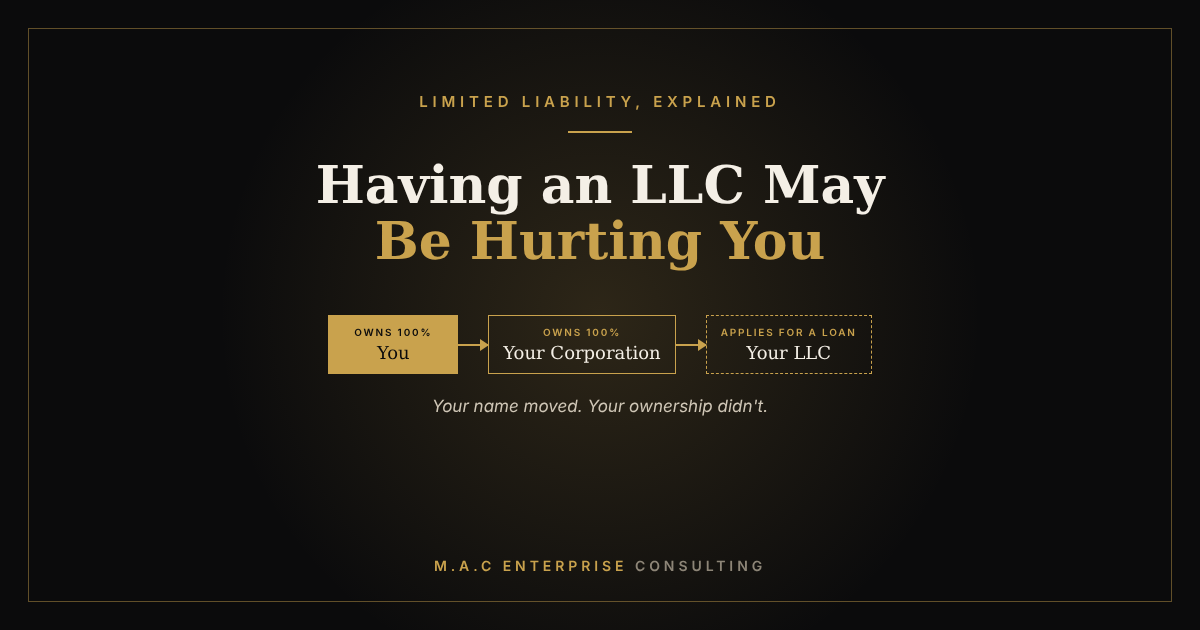
I teach that having an LLC may be hurting you.
That usually gets a reaction.
Somebody always points out that big companies use LLCs.
General Motors’ main operating company is an LLC.
McDonald’s runs its U.S. business through an LLC.
Chrysler, Jeep and Dodge are built by an LLC.
Meta, Google, Amazon and Walmart all have LLCs in their structures.
So how could an LLC possibly be hurting anybody?
I’m not saying the LLC is a bad structure.
I’m saying most people are using it in a way that quietly puts their own name back on the line, and nobody explains how that happens.
So let me explain it.
First, What Does “Limited Liability” Actually Mean?
Before we go any further, we need to understand the words.
Most people form a Limited Liability Company without ever stopping to ask what “limited liability” means.
Start with two simple ideas.
This isn’t the accounting textbook definition, but it’s the clearest way to think about it:
- An asset puts money in your pocket. Rental property, a business that earns income, equipment that produces revenue.
- A liability takes money out of your pocket. A liability is a bill.
- A loan balance is a liability.
- A credit card balance is a liability.
- A judgment from a lawsuit is a liability.
- A tax bill is a liability.
“Limited liability” means the business’s bills are supposed to stay with the business.
If the LLC owes a vendor, loses a lawsuit or can’t pay a debt, the people it owes are generally limited to what the LLC owns.
They’re not supposed to reach your house, your car or your personal bank account.
That’s the promise.
Now here’s the catch.
Limited liability only protects you from bills that legally belong to the business.
It can’t protect you from a bill that legally belongs to you.
So ask yourself: who is responsible for the income taxes on your LLC’s profit?
For a single-member LLC, by default, the answer is you.
The LLC doesn’t pay its own federal income tax.
The profit lands on your personal return, and you pay the tax.
That tax bill is your liability, not the business’s, so the “limited liability” in your LLC’s name does nothing to limit it.
(An LLC can file an election to be taxed as a corporation. But most single-member LLCs never do, and the default is what we’re talking about here.)
The same thing happens when you personally guarantee a business loan.
The moment you sign, you’ve promised to pay that business debt yourself if the business doesn’t. Limited liability can’t limit a liability you agreed to take on personally.
Keep that in mind, because it’s the key to everything that follows.
Start With Three Questions
I ask every business owner the same three questions. Answer them honestly:
- If the business is sued, do you want to be sued personally?
- If the business needs a credit card, a line of credit, a business loan or equipment financing, do you want the bank to base its decision on your personal credit?
- Do you want to be personally responsible for the business’s taxes?
Almost everyone says no, no and no.
If that’s you, let me show you why a single-member LLC may be working against all three answers.
I’m going to start with number three, because it sets off a chain reaction that runs right back up to number one.
Question 3: The Taxes
Here’s what most people don’t know: there is no LLC tax return.
When you own an LLC by yourself, the IRS automatically treats it as a disregarded entity.
That means the IRS ignores the LLC for income tax purposes.
The business income goes on a Schedule C, and that Schedule C is attached to your personal Form 1040.
So the business doesn’t file its own return. You do. The business’s income is your income, and the business’s taxes are your taxes.
(If you have a partner, the default is a partnership return, Form 1065. But the profit still flows to each owner’s personal return on a K-1. Same result.)
That’s the answer to question three.
And it leads straight to question two.
Question 2: Whose Credit the Bank Uses
Now you go to the bank for a loan or a line of credit. The bank asks for the business’s tax returns so it can see the business income.
But there is no business tax return.
The business income is sitting on your personal 1040. So the bank has to go through your taxes to see the business.
And the bank’s next thought is simple: the business income is on your personal return, so we can’t separate the business from you.
We can’t ignore you.
So they ask you to co-sign, or in banking terms, to personally guarantee the loan.
That’s the answer to question two.
Your personal credit is now the deciding factor.
Question 1: Getting Sued Personally
Once you personally guarantee a debt, you’ve agreed to pay it yourself if the business doesn’t.
Many business credit card agreements go a step further and make you jointly and severally liable with the company, which means the lender can come after you, the business or both.
So if the business defaults on that debt, the lender doesn’t have to stop at the LLC.
It can sue you personally, and your personal assets are on the table.
That’s the answer to question one.
The LLC didn’t fail. You signed away its protection for that debt, because the way the LLC was set up gave the bank no other choice.
That’s why I say a single-member LLC may be hurting you.
One tax default leads to the personal guarantee, and the personal guarantee leads to personal liability.
“But the Biggest Companies in America Use LLCs”
They do.
Here are some of the best-known ones.
Look closely at the second column.
| The LLC | What it does | Who owns it |
|---|---|---|
| General Motors LLC | GM’s main U.S. operating company | General Motors Company, a publicly traded corporation |
| McDonald’s USA, LLC | Runs McDonald’s U.S. business | McDonald’s Corporation, a publicly traded corporation |
| FCA US LLC | Makes Chrysler, Jeep, Dodge and Ram vehicles | Stellantis N.V., a publicly traded global automaker |
| Meta Platforms Technologies, LLC | Meta’s virtual reality business, formerly Oculus | Meta Platforms, Inc., a publicly traded corporation |
| Google LLC | Google’s core business | XXVI Holdings Inc., owned by Alphabet Inc., a publicly traded corporation |
| Amazon.com Services LLC | Part of Amazon’s U.S. operations | Amazon.com, Inc., a publicly traded corporation |
| Wal-Mart Stores Texas, LLC | Part of Walmart’s operations in Texas | The Walmart Inc. corporate family |
Notice anything?
Not one of these LLCs is owned by a person.
Every single one sits under a corporation, and every one of those corporations has billions in assets, audited financials and its own credit rating.
It’s Easy to Google. It’s Harder to Compare.
Anyone can type “Google LLC” or “General Motors LLC” into a search bar and see the letters L-L-C.
That part is easy. And then the conclusion comes fast: “See? Google is an LLC. So my LLC is fine.”
But stop and look at what’s being compared.
You’re comparing your single-member LLC to a billion-dollar company.
And you didn’t start in the same place they did.
You started as a disregarded entity owned by a person. They didn’t.
When you formed your LLC, you were the only member.
The IRS disregarded the LLC and put the business income on your Schedule C, on your personal 1040.
From day one, the business was tied to you, your Social Security number, your tax return and your personal credit.
Google didn’t start that way.
Google started as a corporation. It was a corporation for almost 20 years, building revenue, credit and assets, before it converted into Google LLC in 2017. And when it converted, its owner was another corporation, not a person.
General Motors LLC was formed in 2009 as part of GM’s restructuring, already owned by a corporation.
McDonald’s USA, LLC, FCA US LLC and Meta Platforms Technologies, LLC all sit under corporations too.
Here’s the technical part that matters.
An LLC owned by one corporation can still be disregarded for tax purposes. But when it’s disregarded, its income goes onto the corporation’s tax return, not a person’s 1040.
So when a bank looks for Google LLC’s income, it finds a corporation with its own return, its own audited financials and its own credit rating.
When a bank looks for your LLC’s income, it finds you.
Same three letters.
Completely different starting point.
“Well, I’ll Just Make My Corporation the Member”
That’s usually the next response. And yes, you can. We’ll walk through exactly what that does below.
But understand the difference.
The big companies built the corporation first, gave it years of revenue and credit history, and then put LLCs underneath it.
The corporation was the foundation, not the LLC.
When you form a brand-new corporation and slide it in as the member of your existing LLC, you’re copying the diagram without the foundation.
The corporation is new. It has no history, no business credit and no balance sheet.
So when the bank looks at it, it keeps looking until it finds the person who owns it.
That’s still you.
So when someone compares your LLC to these, they’re making two comparisons that don’t line up:
They’re comparing public companies to private ones.
These are subsidiaries of companies traded on the stock market, worth tens or hundreds of billions of dollars.
They’re comparing large corporate structures to a single-member LLC.
Google started as a corporation and converted into Google LLC in 2017, with a corporation as its only owner.
Blackstone went the other way at the top. In 2019 it converted its parent company from a partnership into a corporation, and it uses LLCs and partnerships underneath.
When an LLC sits under a corporation like that, its income rolls into the parent corporation’s tax return.
There is no Schedule C.
There is no founder’s 1040.
And when money is borrowed, the parent corporation’s balance sheet and credit rating stand behind it.
Nobody asks the CEO of McDonald’s to personally guarantee a loan for McDonald’s USA, LLC.
And the private example proves my point.
The Trump Organization is private and is built on a large number of LLCs.
Yet reporting in 2017 found that Donald Trump personally guaranteed roughly $300 million in Deutsche Bank loans, including financing for the Doral golf resort in Miami and the Old Post Office hotel in Washington, D.C.
All those LLCs, and the lender still wanted a person’s signature.
So the comparison can’t be “they have LLCs, so you should too.”
The real question is what sits on top of the LLC, and whose name is on the guarantee.
The Real Question: What Happens When a Corporation Is the Member?
This is where a lot of the confusion is.
You’ll hear people say: just make a corporation the member of your LLC.
To answer that honestly, you have to look at it through two rulebooks, not one.
Two Rulebooks: State Law and Federal Law
State law creates your LLC.
You file articles of organization with the Secretary of State, and under state law your LLC is a separate legal entity.
That’s where the liability protection comes from.
But you can’t run a business on state statute alone.
The moment you get an EIN, open a bank account, invoice a client, hire someone or file a tax return, you’re operating under federal rules too.
And the federal rules look at your LLC very differently.
Don’t take my word for it. When you apply for an EIN for an LLC, the IRS’s own application tells you this:
- “A limited liability company (LLC) is a structure allowed by state statute.”
- “For federal tax purposes, an LLC may be treated as a partnership or a corporation, or be disregarded as an entity separate from its owner.”
- “An LLC’s members may include individuals, corporations, other LLCs, or foreign entities.”
- “LLCs are not incorporated and do not file articles of incorporation.”
Read that again.
The IRS calls the LLC a structure allowed by state statute.
Then it says that for federal purposes, the LLC gets treated as something else: a partnership, a corporation or nothing at all.
Your LLC is separate from you in the eyes of the state.
By default, it’s the same as you in the eyes of the IRS.
Most people only learn the first rulebook.
So let’s walk through both, one question at a time.
State Law: Can a Corporation Be a Member of an LLC?
Yes.
Every state’s LLC law says who can be a member, and it does it through the definition of the word “person.”
An LLC member is a “person” who has been admitted to the LLC.
Then each state defines “person” to include corporations.
Here’s what the law says in eight states:
| State | The law | Who counts as a “person” (and can be a member) | Can a corporation be a member? |
|---|---|---|---|
| California | Cal. Corp. Code § 17701.02 | An individual, partnership, trust, estate, association, corporation, LLC or other entity | Yes |
| Delaware | 6 Del. C. § 18-101 | A natural person, partnership, LLC, trust, estate, association, corporation and others | Yes |
| Florida | Fla. Stat. § 605.0102 | An individual, business corporation, nonprofit corporation, partnership, LLC and other entities | Yes |
| Georgia | O.C.G.A. § 14-11-101 | An individual or a business entity, which includes a corporation | Yes |
| Nevada | NRS 0.039 | A natural person or any business organization, including a corporation, partnership or trust | Yes |
| New York | N.Y. LLC Law § 102 | A natural person, corporation, partnership, LLC, trust and other entities | Yes |
| Texas | Tex. Bus. Orgs. Code § 1.002 | An individual or a corporation, partnership, LLC and other entities | Yes |
| Wyoming | W.S. § 17-29-102, using W.S. § 8-1-102 | An individual, partnership, corporation or any other entity, public or private | Yes |
East coast, west coast, the South, the Mountain West.
The answer is the same everywhere, and the IRS’s own EIN application agrees: an LLC’s members may include corporations.
So this part isn’t a debate.
State Law: Can a Corporation Be the Only Member?
Yes.
That’s exactly how most of the big-company LLCs above are set up.
A corporation can own 100% of an LLC.
But notice what none of these state laws say.
Not one of them says that making a corporation the member changes who owns the business, how the IRS taxes it or what a lender can require before it lends money.
State law answers who can be a member.
That’s all it answers.
For everything else, you have to turn to the second rulebook.
Federal Law: How Does the IRS See That LLC?
The IRS doesn’t care that your LLC is a separate entity under state law.
It looks at who the members are and puts the LLC in one of its three boxes.
Here’s what that looks like depending on who you make the member, assuming you never file an election to change it:
| Who is the member? | How the IRS treats the LLC | Where the income lands | Who pays the income tax? |
|---|---|---|---|
| You, alone | Disregarded, treated as a sole proprietorship | Schedule C on your 1040 | You |
| You and your corporation | Partnership, because there are two members | Form 1065, with K-1s to you and the corporation | You and the corporation, each on its share |
| Your S corporation, alone | Disregarded into the S corporation | The S corporation’s Form 1120-S, then a K-1 to your 1040 | You |
| Your C corporation, alone | Disregarded into the C corporation | The C corporation’s Form 1120 | The corporation |
Look at what that table shows.
Making a corporation the member doesn’t give the LLC its own tax identity.
A single-member LLC owned by a corporation is still disregarded. It just gets disregarded into the corporation instead of into you.
And only one of those four setups takes the income off your personal return: a C corporation as the only member.
If your corporation is an S corporation, the income comes right back to your 1040.
Federal Law: Does the EIN Separate You From Your Social Security Number?
No.
This is one of the biggest myths out there.
A lot of people get an LLC and an EIN because they don’t want to use their Social Security number for anything. That’s the whole idea behind “EIN-only funding.”
But here’s what actually happens:
- When a client asks your LLC for a W-9, the IRS instructions say a disregarded LLC lists its owner’s name and tax ID number, not its own EIN.
- If you’re the owner, that’s your SSN.
- If your corporation is the owner, it’s the corporation’s EIN, and you own the corporation.
- When you open the business bank account, federal rules require the bank to identify the real people who own the business, directly or indirectly, and collect their identifying information, including their Social Security numbers.
- Putting a corporation in between doesn’t change that.
- The bank still collects yours.
- When you apply for funding, the lender asks for the tax return. Under the default rules, that’s your 1040.
The EIN is an ID number for the business.
It doesn’t erase the person behind it.
If I Make My Corporation the Member, Does My Name Come Off?
Now put both rulebooks together:
- Off the LLC’s membership under state law? Yes. If the corporation is the only member, you’re no longer listed as a member of the LLC.
- Off the tax return? Only if the corporation is a C corporation. If it’s an S corporation, the income still lands on your 1040.
- Off the bank’s records? No. The bank still identifies you as the owner.
- Off the loan? Keep reading.
Here’s the part that gets skipped: you still own the corporation.
Your name moved up one level.
Your ownership didn’t go anywhere.
If you own 100% of the corporation, and the corporation owns 100% of the LLC, then you indirectly own 100% of the LLC.
Lenders and the SBA trace ownership all the way up the chain to the actual people.
So what happens when that LLC applies for an SBA loan?
This is where it all connects.
Let’s use an example:
- You own 100% of Main Street Holdings Inc.
- Main Street Holdings Inc. owns 100% of Main Street LLC
- Main Street LLC applies for a $150,000 SBA loan
SBA rules say anyone who holds at least a 20% ownership interest generally must guarantee the loan.
That 20% test counts direct and indirect ownership.
And entities that own 20% or more have to guarantee too.
So who signs?
- The corporation signs, because it owns 100% of the LLC.
- You sign, because you own 100% of the corporation, which means you indirectly own 100% of the LLC.
You didn’t remove your personal guarantee.
You added a second one.
SBA guidance also says ownership can’t be structured just to get around the 20% threshold.
And this is the same whether your LLC was formed in California, New York, Florida, Nevada, Texas, Wyoming, Delaware or anywhere else.
The SBA is a federal program.
Its guarantee rules don’t change based on which state’s LLC law you formed under.
That’s the disconnect.
Moving your name off the LLC doesn’t move your ownership.
And ownership is what the bank and the SBA look at.
So Is a Corporation as the Member Useless?
No, and I want to be fair about this. Putting a corporation in as the member can do real things:
- If the corporation is a C corporation, the LLC’s income goes on the corporation’s tax return instead of your Schedule C. That helps with question three.
- It adds a layer between you and the LLC’s day-to-day business.
- It’s the same basic shape the big companies use.
But it doesn’t automatically fix question two or question one.
If the corporation is an S corporation, the income passes through to your personal return on a K-1 anyway.
And a brand-new corporation has no revenue history, no business credit and no balance sheet.
So the lender still looks to you.
General Motors LLC’s owner is a corporation with billions in assets and decades of credit history.
Your LLC’s owner would be a corporation you formed last month.
Same diagram.
Completely different result.
Side by Side
| Single-member LLC you own | LLC owned by your new corporation | A Fortune 500 LLC (like GM or McDonald’s) | |
|---|---|---|---|
| Where the income is reported | Schedule C on your 1040 | The corporation’s return (C corp) or your 1040 on a K-1 (S corp) | The parent corporation’s return |
| Who the lender looks at | You | The corporation, then you | The parent corporation |
| SBA personal guarantee? | Yes | Yes. The corporation and you both sign. | Not applicable. It borrows on its own credit. |
| What backs the debt | Your personal credit and assets | Your personal credit and assets | Corporate assets and a credit rating |
The Bottom Line
The LLC isn’t the problem. Not understanding how it works is the problem.
A single-member LLC puts the business income on your personal return. That gives the bank a reason to underwrite you. That leads to a personal guarantee. And the personal guarantee puts you back on the hook for that debt.
Making a corporation the member changes whose name is on the LLC. It doesn’t change who owns it. Until the business has its own tax return, its own credit, its own bank account, clean books and real operating history, the lender is still going to look for a person to sign.
Bringing It Full Circle: Why I Say the Legacy Builder Changed My Life
I want to end where I started.
I had an LLC. I got sued. I got hit by a merchant cash advance I didn’t fully understand. And I found out I had signed a personal guarantee. My LLC did exactly what this whole post describes. It kept me in the picture: my income, my credit, my signature, my name.
That’s why I teach this. And that’s why I tell people the Legacy Builder changed my life.
The Legacy Builder Is Built for You, by Yourself

Google has Alphabet.
GM has General Motors Company.
McDonald’s has McDonald’s Corporation.
Every LLC in that table has a corporation standing behind it.
You don’t have shareholders, a board of directors or a credit rating.
You have you.
So the real question is: how does one person build a structure where the business can stand on its own and lean on its own corporations instead of on you?
That’s what the Legacy Builder is.
Here’s how it’s built:
- The trust sits at the top and protects everything. You’re connected to the trust.
- The holding company is a corporation that owns the assets. The trust has the relationship with the holding company.
- The parent company sits under the holding company and owns your operating company.
- The operating company is set up in your home state. It’s the business that serves customers, signs contracts and takes on the day-to-day risk.
- The property management company handles the real estate, so property isn’t sitting in your personal name or in the same company that faces your customers.
- The nonprofit works alongside the structure for giving back and charitable planning.
The holding company, parent company and property management company are formed in a state like Wyoming.
Wyoming has no state corporate income tax and no personal income tax, and it doesn’t require owners to be listed in its public business filings.
So your name stays out of the public record.
Let me be clear: privacy isn’t hiding.
The bank and the IRS will still know exactly who you are.
That’s federal law, and we play by it.
Privacy keeps your name off a public search.
The structure is what keeps the liability separated.
That’s what I mean by own nothing, control everything.
The assets sit in the holding company.
The risk sits in the operating company. A problem in one company is designed to stay in that company instead of reaching everything you’ve built.
Everything Is About Timing
Here’s where people go wrong.
They form five companies on Monday and expect five companies’ worth of protection on Friday.
It doesn’t work that way. A brand-new company with no history is just a name.
Every company in the structure has to go through its own Journey to Success:
- Business planning
- Business identity
- Business registration
- Branding
- Business credit
- Bookkeeping
- Business contracts
- Business protection and maintenance.
- Each one gets its own EIN, its own bank account, its own books, its own credit file and its own track record.

Once each company has that foundation, that’s when ownership can start moving out of your name and into the structure.
You do it the right way, with the righ help, and with your bank’s records updated, because that’s the rule.
Step by step, the companies start carrying the weight.
Step by step, you come out of the picture.
How You Fund It While It Builds
Remember what we covered: the SBA is going to require a personal guarantee no matter what structure you use. That’s the rule.
So the Legacy Builder isn’t about getting around the SBA.
It’s about building companies that, over time, don’t need you to sign.
That’s why I teach the Stripe strategy.
Once your business has been processing payments through Stripe for at least three months, Stripe Capital can make financing offers based on your sales history on Stripe, not your tax returns.
Stripe says that if it runs a personal credit check, it doesn’t affect your personal credit score.
And Stripe reports loan performance for U.S. businesses to the Small Business Financial Exchange, which helps build your business credit history.
Use that funding to build.
Put it into marketing.
Grow and scale the business.
Do it for two years, three years if you have to.
Every month, those corporations are building their own revenue, their own portfolios and their own credit, until they can start leaning on themselves.
One warning from experience: read every offer.
Some Stripe Capital offers are loans and some are merchant cash advances.
You already know what a merchant cash advance I didn’t understand did to me.
Know exactly what you’re signing.
What It Looks Like When It Works
When I went to get a commercial real estate loan, I didn’t walk in as one guy with an LLC. I used two corporations as the guarantors.
That’s the difference.
Not a publicly traded company.
Not a billion-dollar balance sheet.
One person with a structure built the right way, over time.
Back to the Three Questions
Now run the Legacy Builder through the same three questions:
- Taxes? A C corporation is its own taxpayer. It files its own return. The business income isn’t sitting on your 1040.
- Credit? Each corporation builds its own credit file, so over time the lender can look at the company instead of you.
- Sued? The liability is separated across the companies, and the assets sit in the holding company, not in the company that faces customers.
A single-member LLC keeps you in the picture under both rulebooks.
The state sees a separate entity, but the IRS, the bank and the lender see you.
A C corporation is separate under both: a separate entity under state law and a separate taxpayer under federal law.
We play by both rulebooks.
We just use the corporation to do it.
That’s why I say the Legacy Builder changed my life.
It’s how I went from being sued and personally on the hook to having corporations stand behind my deals.
And I’ve watched it change the lives of the people in our community who built it the same way: one company and one step at a time.
Why I’m Pushing So Hard Before December 31
I’m trying to help as many people as I can before the end of the year, because things are changing on January 1, 2027.
Going forward, we’re going to focus on the people who understand this and are ready to build. I don’t mean that in a negative way. It’s exactly why education matters so much.
If you’re ready to start learning, The Corporation Blueprint is $497.
If you’re ready to build the full structure, the Legacy Builder is part of our year-end sale, and any package purchase comes with 3 months of free mentorship.
I was sued.
That’s why I teach this.
So go back to the three questions one more time.
If you answered no, no and no, don’t just get an LLC.
Build a structure that can answer no for you.
This post is for education only. I’m not your attorney or CPA. Talk to a qualified professional about your specific situation before you form, convert or restructure an entity, or sign any loan documents.
Sources
SBA guarantee rules
- 13 CFR § 120.160: SBA personal guarantee requirement for 20% owners
- Pioneer Capital Advisory: SBA guarantees count direct and indirect ownership
- Starfield & Smith: Entities owning 20% or more must guarantee
- Coleman Report: Ownership can’t be structured to avoid the 20% threshold
State LLC laws
- California: Corp. Code § 17701.02, definitions of “member” and “person”
- Delaware: 6 Del. C. § 18-101, definition of “person”
- Florida: Fla. Stat. § 605.0102, definition of “person”
- Georgia: O.C.G.A. § 14-11-101, definitions of “member” and “person”
- Nevada: NRS 0.039, definition of “person”
- New York: LLC Law § 102, definitions of “member” and “person”
- Texas: Business Organizations Code § 1.002, definition of “person”
- Wyoming: W.S. § 8-1-102, definition of “person” (used by the LLC Act, § 17-29-102)
Companies
- General Motors Company: SEC list of subsidiaries, including General Motors LLC
- McDonald’s Corporation: SEC list of subsidiaries, including McDonald’s USA, LLC
- FCA US LLC: Form 10-K
- Meta Platforms, Inc.: SEC list of subsidiaries, including Meta Platforms Technologies, LLC
- FCC filing: Google LLC is wholly owned by XXVI Holdings Inc., owned by Alphabet Inc.
- TechCrunch: Google Inc. converts to Google LLC
- Blackstone 8-K: Conversion from a partnership to a corporation, 2019
- The Real Deal: Trump personally guarantees about $300M in Deutsche Bank loans


