
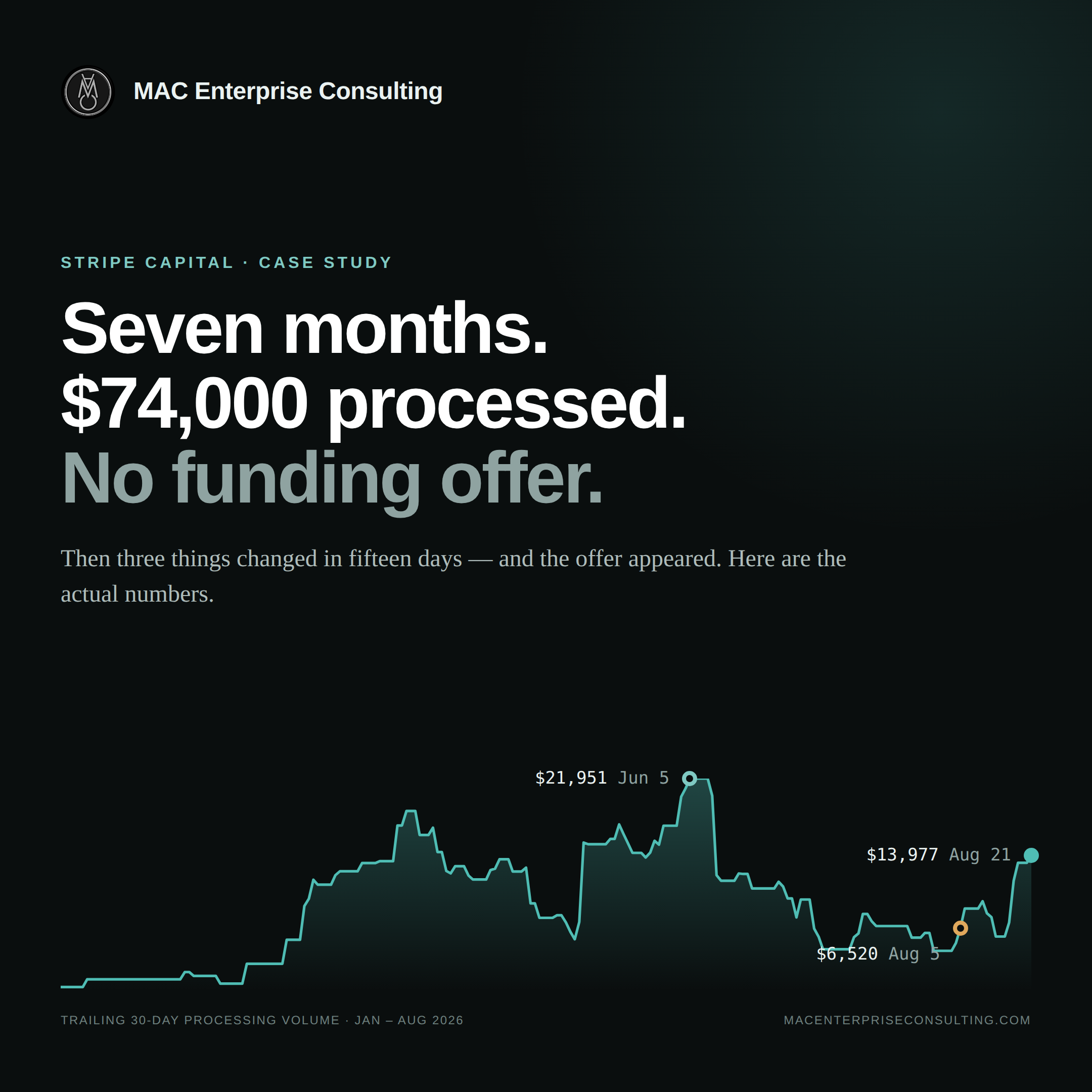
Here’s what finally changed — with the actual numbers, and an honest account of what I can and can’t prove.

For seven months I asked myself the wrong question.
The question I kept asking was: have I met Stripe’s requirements?
I had.
I met them in April.
And then nothing happened for four more months.
The better question — the one I only understood after I pulled my own transaction data apart line by line — turned out to be this: what does the whole picture of my account look like on the day Stripe evaluates it?
This is the story of my own Stripe account, with the actual numbers.
I’m going to show you what Stripe publishes, what my data shows, what I think happened, and what I can’t prove.
Those are four different things, and most of what you’ll read online about Stripe Capital mashes them together.
First, what Stripe Capital actually is
Stripe Capital is financing offered to businesses that process payments through Stripe.
You don’t apply for it in the traditional sense.
Stripe evaluates your account on its own schedule, and if you qualify, an offer appears in your dashboard and an email arrives.
What most people don’t realize is that “Stripe Capital” describes two different products:
A loan.
Issued by a bank partner.
It has a maximum term and periodic payments.
If your sales don’t cover the minimum in a given window, Stripe debits the difference from your bank account.
A merchant cash advance.
This is not a loan and it isn’t a credit transaction.
A financing partner purchases a portion of your future receivables.
There’s no payment schedule and no interest clock — a fixed percentage of every sale is withheld until the agreed total is collected.
You don’t get to choose which one you’re offered.
I’ve had some practice with this.
Since May 2024, Stripe has extended my businesses 15 separate financing offers totalling more than $1.4 million in available funding.
Not one of them required a personal guarantee, and Stripe states that applying doesn’t affect your credit.
Every one of those fifteen was a term loan.
This one was different — my first offer funded by YouLend, and my first merchant cash advance.
Same dashboard, same “Stripe Capital” heading, a fundamentally different instrument.
Which is exactly why the distinction above isn’t academic: if I’d assumed this worked like the fifteen before it, I’d have misread the terms.
That distinction matters more than it sounds, and I’ll come back to it when we talk about what the money actually costs.
What Stripe publishes about eligibility
This part is not a secret, and it’s worth reading directly rather than through somebody’s summary.
For US businesses, Stripe states minimum requirements:
- Processing payments on Stripe for 3 or more
- A processing volume of at least $5,000 per year, and an average of $1,000 per month over the last three months
- Good standing with Stripe Capital
- A US-based business
And then Stripe says something people skip right past:
Meeting the minimum eligibility requirements doesn’t guarantee that your business qualifies for a Stripe Capital offer.
Beyond the minimums, Stripe names four things its underwriting considers:
a growing business (“businesses with positive growth trajectories are more likely to be eligible”),
a steady processing record (“a consistent processing record with few periods of low or zero volume”),
a large customer base, and a low dispute rate.
Stripe also says this, which becomes important later:
If your business has multiple Stripe accounts, a financing offer might be generated based on the combined information from those accounts.
That’s the published record.
Everything after this point is my account.
My numbers
My tax practice started processing on Stripe on January 14, 2026.
Between then and August 21, the account processed $74,301.82 across 69 payments from 56 distinct customers.
Average payment $1,077.
I hit three months of history on April 14.
My trailing three-month average at that moment was $8,610 per month — more than eight times Stripe’s stated $1,000 minimum.
No offer.
Not in April, not in May, not in June or July.
Here’s the part I didn’t see until I charted it.
My trailing 30-day processing volume peaked at $21,951 on June 5, and then fell for eight straight weeks to $6,520 on August 5. A 70% decline.
July was my worst month of the year — four payments, $4,145 — and included a full week with no volume at all.
There was another zero-volume week in June.
Read Stripe’s four considerations again with those numbers in hand.
Positive growth trajectory. My trajectory was falling off a cliff.
Few periods of low or zero volume. I had two dead weeks in eight.
On paper I qualified. In shape, my account looked like a business winding down.
That gap between qualifying and looking healthy is the whole lesson.
The three things that changed in August
August 6 — my tax business moved to its own login
This one needs care, because I initially described it to myself incorrectly.
I had one Stripe login holding three separate Stripe account IDs:
my consulting company’s website payments, my masterclass, and my tax office.
Three businesses, three EINs, three addresses.
Two of those accounts already carried Stripe Capital financing.
The tax office — processing since January — had never received an offer.
On August 6, I transferred the tax services account so it sat under its own login.
The Stripe account ID never changed.
Its seven months of processing history came with it; nothing reset.
What changed was what sat beside it.
Go back to Stripe’s own language: a financing offer might be generated based on the combined information from those accounts.
Stripe’s US page also says eligibility is determined by factors related to your Stripe accounts — plural.
On existing debt, it says only that “in some cases, we extend additional offers to you while you’re actively paying your current financing.”
In some cases is doing a lot of work in that sentence.
My theory: while my tax practice sat inside a picture that already carried two active advances, it was never being read on its own.
I cannot prove that.
Stripe never tells you whether it combined your accounts, and its language is written around one business with several accounts, while mine are three distinct entities.
The mechanism is published.
Whether it was applied to me is my inference, not a fact.
But it’s the only explanation that covers April and May, when my volume was strong and nothing happened.
August 10–16 — the numbers started recovering on their own
Before I did anything else, five payments totalling $4,199 came in across one week — my busiest stretch since May. Worth stating plainly, because it complicates the tidy version of this story: the recovery had already started.
August 17 and 18 — recurring revenue, created and then collected
On August 17 I set up three weekly subscriptions: $500, $1,000 and $375 — $1,875 a week.
On August 18, all three collected.
Those are two different events and I want to separate them, because this is the detail I’d have glossed over a month ago.
Creating a subscription produces a promise. Stripe Billing can now calculate MRR and ARR from it.
Collecting a subscription produces a payment. Only the second one is processing volume — and processing volume is what Stripe’s published eligibility language is actually written around.
Between August 16 and August 21, my trailing 30-day volume went from $7,069 to $13,977 — it nearly doubled in five days. Distinct payers in that window went from 7 to 12.
Full disclosure, because it matters: the largest of those three subscriptions bills my own consulting company — an intercompany services arrangement — and it’s 53% of that MRR figure.
I’m including it because I’m showing you what Stripe saw, not the version that flatters my theory.
From unrelated customers only, the recurring revenue is about $3,805/month, not $8,153.
August 22, 2:39 AM — the offer
Based on MAC Enterprise Tax Services’s strong performance, you’re prequalified for a financing offer through Stripe Capital.
Financing of up to $4,990. A $992 fixed fee. 17.5% of sales allocated toward repayment.
Sixteen days after the account moved to its own login.
Five days after the subscriptions were created.
Four days after the first recurring payments collected.
What I can prove, and what I can’t
I want to be careful here, because “I did X and got funded” content is everywhere, and most of it is somebody guessing.
What I can prove: the dates, the amounts, the sequence. My export reconciles to Stripe’s own balance summary to the penny. The offer email is timestamped after every change described above.
What I can’t prove: which change caused it, or whether any of them did. Three things moved inside sixteen days, and Stripe reviews accounts on its own recurring cycle regardless of what I do. Stripe does not publish its underwriting model.
Anybody who tells you they’ve reverse-engineered it from one account is selling you something.
What I’d say honestly is this: my account stopped looking like a business in decline and started looking like one that was growing, and it started being read on its own instead of inside somebody else’s balance sheet.
All three changes pushed in the same direction at once.
One more thing my data taught me
While reconciling, I found a $980 gap between my transaction export and my balance summary.
It turned out to be a dispute.
Back in April, my checkout system charged a client $980 twice for the same job.
He saw two identical debits on his bank statement and disputed one.
I reviewed it, confirmed the duplicate was real, and chose not to contest it — the right call for the client, and I’d make it again.
But my Stripe dashboard shows that as “Dispute lost.” One dispute across 70 charges is a 1.43% dispute rate, and dispute rate is one of the four things Stripe names.
Here’s the lesson I’d hand to anybody: the label on your dashboard doesn’t tell your business’s story.
Mine says I lost a dispute.
What actually happened is that I found my own billing error and made the customer whole.
Underwriting reads the code, not the context.
So does anyone else looking at your account — which is why you should know what’s in yours before somebody else forms an opinion from it.
What the money actually costs
This part gets skipped in almost every article about Stripe Capital, and as a tax professional it’s the part I care about most.
- Advance:$4,990
- Fixed fee:$992— 19.88% of the advance
- Total to repay:$5,982
- Withheld:17.5% of every saleuntil it’s collected
There’s no interest clock and no payment schedule.
But watch what happens when you convert it into a rate you can compare against anything else:
| If I keep processing at… | Withheld/mo | Repaid in | Equivalent APR |
|---|---|---|---|
| My recent pace, ~$13,977/mo | $2,446 | 2.5 months | ~131% |
| My lifetime average, ~$10,249/mo | $1,794 | 3.3 months | ~105% |
| Stripe’s own projection | $1,496 | 4.0 months | ~92% |
Notice the direction.
The fee is fixed, so the faster you grow, the faster it repays — and the more it costs in annualized terms.
Growing after you take the money makes it more expensive, not less.
That’s the opposite of how a loan behaves, and it’s why a merchant cash advance is a genuinely different instrument.
None of that makes it a bad product.
$992 to unlock $4,990 right now is a fine trade if the money buys growth worth more than $992 inside a quarter.
It’s a poor trade if it’s covering a gap, because the same 17.5% keeps coming out during your slow weeks too.
That’s a decision, not a rule. Run your own numbers. I’m not your financial advisor.
What I’d tell you to do
Stop treating the minimums as a finish line.
Three months and $1,000 a month gets you considered. It doesn’t get you funded.
I cleared the bar in April and heard nothing until August.
Watch direction, not size.
A $10,000 month that follows a $16,000 month tells a different story than one following a $6,000 month.
Same number, opposite meaning.
Mind the gaps.
Two zero-volume weeks did more damage to how my account looked than any single slow month.
Know what’s sitting under your login.
Which account IDs, which EINs, which ones already carry financing. You can’t see how Stripe combines them, but you can absolutely know what’s in the pile.
Reconcile your own books.
I found a duplicate charge, a dispute I’d half-forgotten, and a $97 fee discrepancy — none of which I’d have caught without pulling the export.
And build revenue that actually collects.
Not subscriptions that exist. Subscriptions that clear.
Where to go from here
Everything above is yours, free. If you want to go deeper, there are two places I teach this properly.
Journey to Success Masterclass
The foundation — the eight steps every business should take before it accepts a dollar from a client.
It’s also where The Stripe Capital Blueprint lives: the full written education behind this article, alongside the rest of the Masterclass ebook library.
See the Masterclass →
Momentum — the Stripe Capital Signal Stack
Continuing education for people already making money.
Members get the tool I built out of this analysis: add your own Stripe export and it scores the signals across your account, in your browser.
Nothing is uploaded.
Join Momentum →
This article describes my own experience with my own Stripe account. It is not affiliated with, endorsed by, or connected to Stripe or YouLend. Nothing here predicts or influences any financing decision, and nothing here is financial, legal, or tax advice. Stripe does not publish its underwriting model.


