
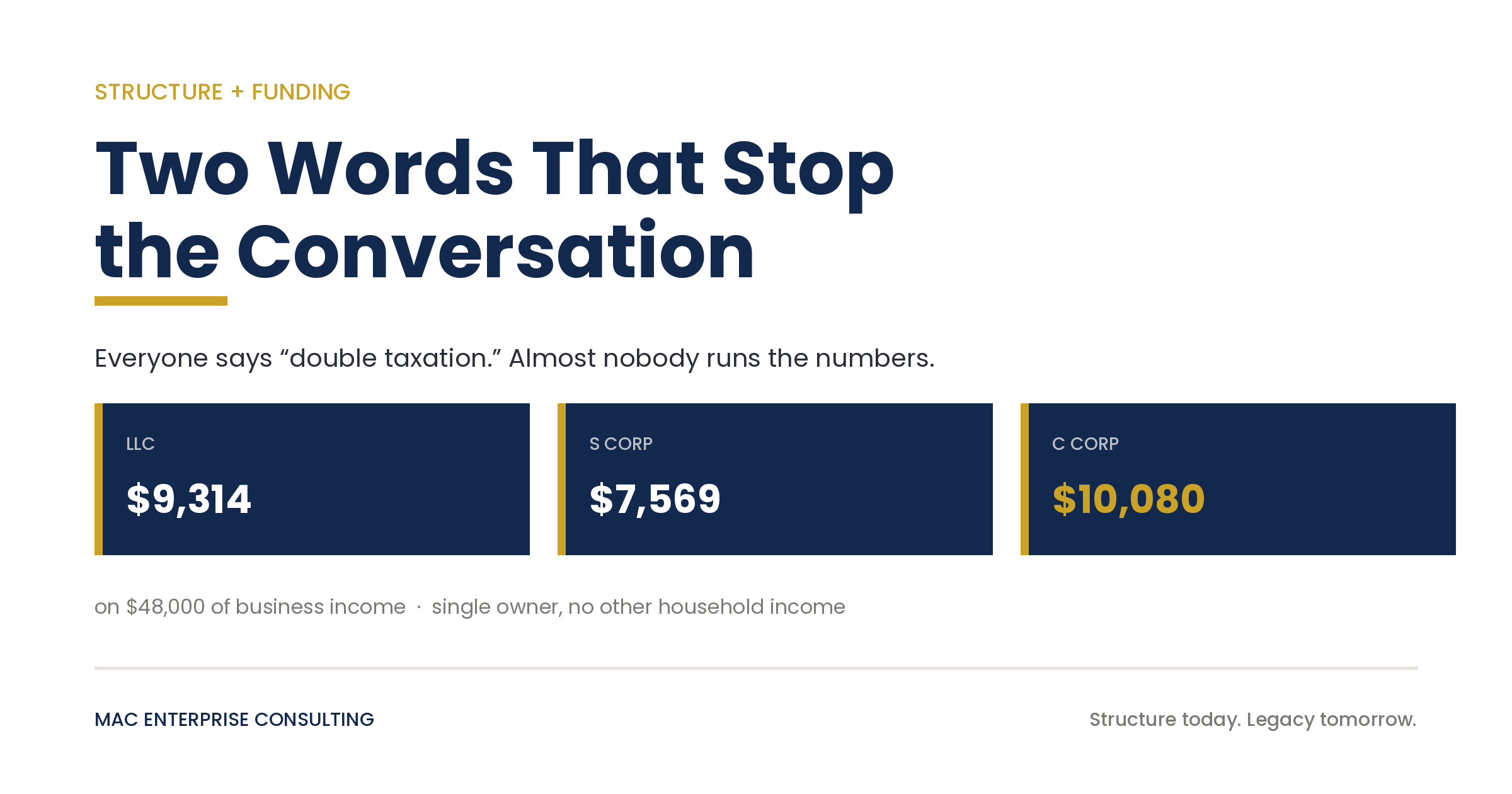
Every time I talk about corporations, someone says the same two words.
Double taxation.
That’s it. That’s the whole argument. And most of the time, the conversation ends right there.
Nobody asks how much. Nobody runs the numbers. Two words, and a business owner walks away from a decision they never actually looked at.
So let’s look at it.
Watch the full breakdown, or keep reading.
The setup
One owner.
No spouse income.
Forty-eight thousand dollars in profit for the year.
Same business, same money, three different structures.
Let’s see what each one costs.
Structure one: the LLC
This is where almost everyone starts, because it’s what everyone tells you to do.
Your LLC doesn’t pay tax.
The profit lands on your personal return.
You pay self-employment tax on it — Social Security and Medicare — and as your own boss you cover both halves.
Self-employment tax: $6,782
Income tax: $2,532
Total: $9,314
Structure two: the S corp
Same business, but now you’ve made a tax election.
The IRS requires you to put yourself on payroll at a reasonable salary.
Say $30,000. The rest comes to you as a distribution, and distributions don’t carry payroll tax.
That’s where the savings come from.
Payroll tax: $4,284
Income tax: $2,946
Total: $7,300
Structure three: the C corp
Now the one everybody’s afraid of.
Your corporation pays tax on its own profit.
Twenty-one percent.
That’s $10,080, gone before you see a dollar.
What’s left — $37,920 — comes to you as a qualified dividend.
And here’s the part nobody mentions: at this income level, that dividend is taxed at zero percent.
No income tax.
No Social Security.
No Medicare.
Corporate tax: $10,080
Tax on the dividend: $0
Total: $10,080
Now put them side by side
| Structure | Total tax | vs. LLC |
|---|---|---|
| S corp | $7,300 | −$2,014 |
| LLC | $9,314 | — |
| C corp | $10,080 | +$766 |
Read that last line again.
The C corp — the one with “double taxation,” the one people run from — costs $766 more per year than the LLC most new owners default to.
That’s $64 a month.
Sixty-four dollars.
That’s the thing two words scared you away from.
Against the S corp it’s $2,800 a year, or about $233 a month.
Still real.
Still a number, not a wall.
So why would anyone pay more?
Here’s the question nobody asks: what does that money buy?
To answer it, you have to understand where your business income lives.
An LLC and an S corp are pass-through entities.
Your business profit doesn’t stay with the business.
It flows onto your personal tax return — through a K-1, onto Schedule E, onto Schedule 1, and finally onto line 8 of your 1040.
Your business income is your personal income.
There is no separating them.
A C corporation is different.
It files its own return — Form 1120.
Its profit stays with it.
It has its own financial identity.
Why does that matter?
Because of who’s on the hook.
When you apply for funding as a pass-through owner, the lender is reading your personal tax return — because that’s the only place your business income exists. And when a lender is underwriting you personally, they usually want a personal guarantee.
A personal guarantee means this: if the business can’t pay, they come after you.
Your house.
Your savings.
Your car.
The business failed, but the debt is yours.
There’s a second cost people miss. A pass-through loss also lands on your personal return, and it reduces the income you qualify on.
A bad year at the business follows you into every application you make.
A corporation’s loss stays with the corporation.
When the entity has its own return, its own revenue history, and its own credit file, it can be underwritten on its own.
That’s the door that opens.
What it opened for me
I ran an LLC. I got sued.
After that, I converted to a C corp and built the entity properly — its own bank account, its own credit file, its own clean books, its own operating history.
What came after:
- Over $1 million in business financing — no personal guarantee
- A corporate card with a $100,000 limit — no personal guarantee
- A company vehicle in the business name — no personal guarantee
I pay more in tax.
About $64 a month more than I would as an LLC.
I would make that trade every single time.
Let me be honest about two things
First: the structure alone didn’t do it.
Converting on Monday does not get you funded on Friday.
A brand-new corporation has no history either.
What made the difference was the entity plus revenue, plus clean books.
None of that came from a book.
It came from failing.
I got sued.
I hit walls I didn’t see coming because nobody told me what was on the other side of the paperwork I was signing.
Every mistake cost me money, and some of them cost me sleep.
That’s what the Masterclass is.
It’s the sequence I had to learn the expensive way, put in order so you don’t have to pay the same tuition I did.
Not theory — the actual steps, in the order they matter.
Second: this isn’t for everybody.
If you’re taking every dollar out as profit, you don’t mind personal guarantees, and you’re fine putting yourself on payroll — then an LLC taxed as an S corp is the way to go.
I’ll tell you that before I take your money.
And if you’re already an S corp, know this before you move: revoking that election generally locks you out for five years without IRS permission.
The part nobody finishes telling you
Here’s what bothers me most.
People are told: get an LLC, it protects you.
Then they walk into a bank, sign a personal guarantee, and hand that protection right back — and nobody warned them it was happening.
Open a business credit card and read the terms.
Most of them say you are jointly and severally liable with the company.
The account is in your business’s name.
You are still on the hook personally, and you never signed a separate guarantee document — it was built into the application you submitted.
Going the bank route instead?
Under 13 CFR § 120.160(a), any holder of a 20% or greater ownership interest generally must guarantee an SBA loan.
SBA grants no waivers except for ESOPs.
That rule applies to an LLC, an S corp and a C corp alike.
An LLC and a corporation give you the same liability shield.
That’s not the difference between them.
What gives your protection away is what you sign.
That’s the sentence I wish someone had said to me before I got sued.
So I’m saying it to you.
The real question
The question was never “is there double taxation.”
Yes. There is.
It’s real, and it cost me.
The question is: what is it costing you, and what is it buying?
For me, at these numbers, it was sixty-four dollars a month to stop putting my personal name behind my business.
Your numbers will be different.
Your goals will be different.
You might run this and decide the S corp is right for you — and that would be a good decision, because you’d have made one.
Just get further than two words before you decide.
The fine print, because it matters
These figures use 2025 federal rules for a single filer with no other household income and a $15,750 standard deduction.
The 0% qualified dividend rate applies while total taxable income stays under about $48,350 for single filers — a working spouse or other income changes that.
The S corp figure assumes a $28,000 reasonable salary; a different salary produces a different result — at $30,000 the total rises to about $7,569. State taxes are not included and vary widely.
This is education, not tax advice.
Run your own numbers with a professional who can see your whole picture.
Ready to build it right?
Masterclass — the foundation. The things you should do before you accept a dollar from a client.
Momentum — continuing education, with live training twice a month.
Start a Business — $99 + state fee
Convert an LLC to a C Corp — $199 + state fee
Legacy Builder — you want us to implement it with you, so you see results faster.
Take the free Business Assessment →
Structure today.
Legacy tomorrow.


