
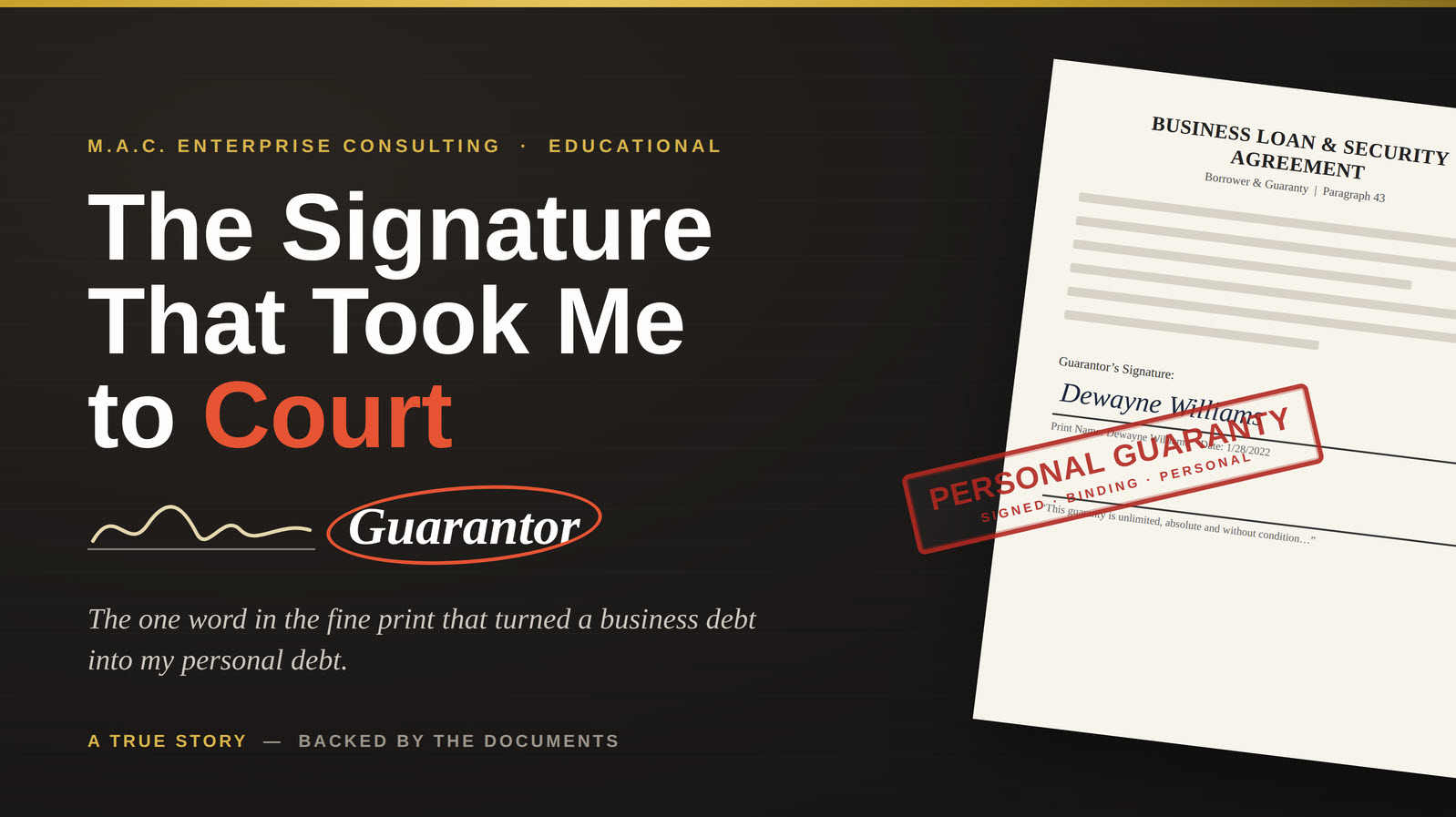
The one word in the fine print that turned a business debt into my personal debt.
Educational information only: This article is for educational purposes only and is not legal advice. Every contract is different, every state’s laws are different, and the legal effect of any agreement depends on its specific language. Before signing any significant business agreement, consult an attorney licensed in your jurisdiction.

I thought my business would protect me.
In 2022, I learned one of the most expensive lessons of my entrepreneurial journey. It wasn’t because I owned an LLC. It wasn’t because I didn’t have a corporation. It wasn’t because I wasn’t working hard enough.
It came down to one word buried inside a contract that I didn’t fully understand before I signed it.
Guarantor.
That single word eventually followed me into court.
Like many entrepreneurs, I believed that once I created a business entity, my personal assets would automatically be protected.
What I learned was something completely different.
Your business structure matters. But so does every word you sign.
Today, before I sign any agreement, I ask myself one question:
In what legal capacity am I signing?
That one question may determine whether a debt belongs to your business — or to you personally.
A corporation cannot hold a pen.
One of the biggest misconceptions I hear from business owners is this: “My corporation signed the agreement.”
No.
Your corporation didn’t sign anything.
A corporation cannot hold a pen.
It cannot walk into a bank.
It cannot click “Accept.”
Although the law recognizes a corporation as a separate legal person, it can only act through human beings who are authorized to act on its behalf.
Every contract a corporation enters is ultimately signed by a person acting for the company.
So the question has never been “did a human sign?”
Of course a human signed.
The real question is:
Who was that person signing for?
The two hats every business owner wears.
Every business owner signs contracts wearing one of two hats. The problem is that most people don’t realize which one they’re wearing until it’s too late.
Hat #1 — The Representative
When you sign as President, CEO, Managing Member, or another authorized officer, you are acting as the company’s representative — telling the other party,
“I have authority to bind this company.”
Done correctly, your signature binds the company, not you personally, unless the agreement separately creates personal liability.
A proper signature block generally looks like this:

The company entered into the agreement.
You simply acted as its hand.
Hat #2 — The Guarantor
A guarantor is completely different.
The company promises to pay — and then you make a second promise: that if the company doesn’t pay, you will.
That second promise changes everything.
It isn’t your corporation failing you.
It’s you voluntarily agreeing to become personally responsible under the terms of the agreement.
The biggest misunderstanding about limited liability.
“I have an LLC, so I’m protected.”
Maybe.
Maybe not.
The confusion starts with the name itself.
It says LIMITED liability — not NO liability.
Read the phrase slowly. Limited is not the same word as none. An entity limits your exposure in certain situations; it does not erase it.
People conflate those two ideas — and that single mix-up is where the trouble begins.

In reality, a business is “separate” in two completely different systems — and being separate in one does not mean you are separate in the other.
Separate for liability — that comes from state law (and every state is different).
When you form an LLC or corporation under state law, the entity becomes a distinct legal entity, and its owners get limited liability: your personal assets are generally shielded from the company’s debts.
A court will set that shield aside only for serious misconduct — commingling funds, undercapitalization, alter-ego use, or fraud.
That is called piercing the corporate veil, and it is something done to you, against your will.
These protections come from state law — and every state wrote its own.
Corporations have been treated as artificial legal “persons” for centuries; the milestone most people cite for constitutional personhood is 1886, in Santa Clara County v. Southern Pacific Railroad — though, tellingly, the statement that corporations are “persons” under the Fourteenth Amendment appeared in the court reporter’s headnote, not the formal opinion, and later cases treated it as precedent.
The LLC is far newer: Wyoming passed the first U.S. LLC statute in 1977, and the states did not adopt at the same time — most enacted their LLC laws between 1992 and 1997, after the IRS clarified how LLCs would be taxed.
The takeaway: the rules that shield you are state rules, and they differ from state to state — so what is true in Texas may not be true in New York.
Separate for taxes and identity — that comes from the EIN (federal).
An EIN is something different. The IRS calls it simply “a federal tax ID number for businesses.”
It identifies your company to the IRS, lets it open a bank account, and lets it begin building credit in its own name.
But an EIN is a tax-and-identity number — not a liability shield.
It does not create the veil, and it cannot protect your personal assets by itself.
And you never really operate in the “state” world alone — the federal system runs at the same time.
You cannot ignore the IRS because your Secretary of State handed you a certificate, and in practice the EIN is requested on virtually every business bank account and loan application.
In fact, for federal income tax a single-member LLC is usually “disregarded as an entity separate from its owner” — the IRS treats you and the LLC as one taxpayer, even while state law still treats the LLC as separate for liability. Two systems, running at once.
Two different answers.
“Pass-through” taxation doesn’t mean what most people think.
Most entities — sole proprietorships, single-member LLCs, and S-corporations — are pass-through entities.
That does not simply mean “the tax bill passes to you.” It means the business itself generally pays no federal income tax; instead its income, losses, and deductions all flow through to the owners’ personal returns.
The company’s entire financial picture lands on your personal return.
Here is why that matters.
Because a business’s money runs through the owner’s personal return and personal credit, lenders underwrite the owner, not just the company — and that reliance on you as an individual is a big reason they so often demand a personal guarantee.
It isn’t that being a pass-through “triggers” a guaranty by law; it’s that your finances and the company’s are already intertwined, and the guaranty simply makes that link explicit and enforceable.
Where people get hung up
Forming the LLC (state law) creates the liability shield.
Getting the EIN (federal) gives the business a tax and credit identity.
Both matter — but neither one, by itself, stops a personal guarantee.
When you sign as guarantor, you reach across both systems and put your own name back on the debt, voluntarily.
A personal guaranty is the opposite of the veil.
Piercing the veil is involuntary — a court takes your shield because of misconduct.
A personal guaranty is voluntary — you handed the creditor the right to reach you, in writing, up front.
That is the real change in the deal.
Not the entity.
Not the EIN.
The signature.
Not every business signature is a guaranty; the word in the fine print decides.
“But I filed Form 8832 — I’m taxed as a corporation.”
Here is the pushback I get, usually from more advanced owners: “I filed Form 8832 and elected to be taxed as a corporation, so my business income isn’t on my personal return anymore.”
On the tax side, that is fair — an LLC really can elect corporate tax treatment and file a corporate return.
But it runs straight into the most under-discussed issue in this entire conversation: being treated as a corporation is not the same as being one.
Two different authorities decide two different things.
Put simply: “your state controls what your business is, and the IRS controls how it’s taxed. An LLC taxed as an S corporation is still an LLC that files an S-corp tax return.”
The IRS says the same thing from its side: an LLC is “an entity created by state statute,” and filing Form 8832 changes only its federal tax classification — the company continues to exist as an LLC under state law.
Form 8832 changes how you are taxed.
It does not change what you legally are.
Public perception: the record still says “LLC.”
Form 8832 is filed privately with the IRS.
It never appears in the public record.
Your Secretary of State registration still says “LLC.”
So to everyone who actually looks you up — a bank, a lender, a credit bureau, a court, a business-credit report — you are an LLC that happens to file a corporate tax return.
You are wearing a corporate tax hat on an LLC body.
That mismatch is exactly why some owners — myself included — choose to actually form a C-corporation when they want separation that is consistent across every system: the legal form, the tax return, and the public record all say the same word.
Three agreements. Three completely different outcomes.
People ask me all the time,
“How do you know all this?”
Because I’ve lived both sides.
Here are three real agreements I signed for my own company.
(Personal identifiers are redacted; the capacity language is not.)

I signed for my company (left) — and then signed again as GUARANTOR (right).
That second signature wasn’t for the company. It was for me. Years later, it became part of a court case.

I signed as the corporation’s Authorized Officer — a representative, not a guarantor of the debt.

Again, I signed as the Merchant Representative — not as a personal guarantor.
Same person.
Same handwriting.
Same signature.
Three completely different legal consequences.
The financial product didn’t determine the outcome.
The words in the agreement did.
Legal terms every business owner should understand.
Before signing any agreement, slow down and read the words.
Some carry far more legal weight than most business owners realize.
Each definition below is drawn from an authoritative legal source — the statute, the code, or Cornell Law School’s Legal Information Institute — followed by what it means in plain English.
Capacity
In contract law, “capacity” describes the character or role in which a person acts.
The Uniform Commercial Code expressly contrasts signing in a “representative capacity” with signing individually.
(A second, separate sense of the word means legal competence to contract — the “ability to make a rational decision based upon all relevant facts and considerations.”) — UCC § 3-402; Cornell Law School, LII.
Plain English: Who are you legally signing as?
Representative
“A person empowered to act for another, including an agent, an officer of a corporation or association, and a trustee, executor, or administrator of an estate.” — Uniform Commercial Code § 1-201(b)(33).
Plain English: You’re signing on behalf of the company.
Guarantor
“A guarantor is a person or entity that assumes the financial obligation of another party in the event that the original party is unable to fulfill their obligation.” — Cornell Law School, Legal Information Institute (Wex).
Plain English: You’re promising to pay if your company doesn’t.
Personally
To sign personally is to add your own name and your own promise to an obligation — as yourself, the human being — rather than only as the company’s agent.— Agency law; UCC § 3-402.
Plain English: The agreement is speaking to you as an individual.
Individually
Signing individually (or “in an individual capacity”) means signing in your own legal capacity, not solely as an officer of the company.
Under UCC § 3-402, a signature that does not clearly show it was made on the company’s behalf can expose the signer personally.— UCC § 3-402.
Plain English: You’re signing in your own name, not solely as an officer of the company.
Jointly and Severally
“When two or more parties are jointly and severally liable… each party is independently liable for the full extent of the” obligation.
Applied to co-guarantors, a creditor may collect the entire debt from any one signer. — Cornell Law School, LII (Wex).
Plain English: A creditor may pursue any one signer for the entire obligation.
Absolute and Unconditional (Guaranty of Payment)
“One who undertakes an absolute guaranty of payment… becomes liable immediately upon default in payment”
by the borrower — the creditor need not first pursue the company or even give notice.
— The Florida Bar Journal, citing Anderson v. Trade Winds Enterprises Corp., 241 So. 2d 174 (Fla. 4th DCA 1970).
Plain English: Your obligation can become enforceable immediately, without the creditor chasing the company first.
Words that make me stop reading — and start paying attention.
Today, before I sign any business agreement, I search the document (Ctrl-F is your friend) for these words:
- Guarantor
- Personally
- Individually
- Jointly and Severally
- Absolute and Unconditional
If I find them, I don’t rush.
I don’t assume.
I slow down, I ask questions, and I make sure I understand exactly what I’m agreeing to before the ink touches the paper.
Before you sign your next agreement.
Don’t start by asking, “Where do I sign?”
Instead ask: Who am I signing for?
Am I signing as President, CEO, or Authorized Officer — a representative?
Or as a Guarantor, individually?
That single question may change your financial future.
The bottom line
A corporation cannot hold a pen.
Every business agreement requires a human signature.
The question has never been whether you signed — it’s in what legal capacity you signed.
One signature may bind your company.
Another may bind you personally.
The ink looks exactly the same.
The legal consequences do not.
References & further reading.
- Fundamentals of Business Law, §15.4 “Liability to Third Parties” (Business LibreTexts) — Agency law; an authorized agent for a fully disclosed principal is not personally liable.
- “Avoiding Personal Liability for Entity-Specific Contracts,” ABA Business Law Today (Nov. 2024) — The proper signature block and how contract language can override it.
- “Corporate Resolution for Signing Authority” (Diligent) — Actual vs. apparent authority; board resolutions.
- “Corporate Signatures: Why Disclosing Corporate Titles Protects Officers” (Arnall Golden Gregory LLP) — Why disclosing the entity and your title matters.
- Uniform Commercial Code § 3-402, “Signature by Representative” (Cornell Law School, LII) — When a representative is, or is not, personally liable on a note or check.
- “How to Guarantee Enforcement of a Guaranty Agreement,” The Florida Bar Journal — Guaranty of payment vs. collection; “absolute and unconditional”; Anderson v. Trade Winds Enterprises Corp., 241 So. 2d 174 (Fla. 4th DCA 1970).
- “A Difference That Could Matter: Borrower versus Guarantor” (Lexology) — Practical consequences of signing as a guarantor.
- “Piercing the Corporate Veil” (Cornell Law School, Wex) — Limited liability and the misconduct courts require to reach owners.
- Uniform Commercial Code § 1-201, Definitions — “Representative” & “Person” (Cornell Law School, LII) — Statutory definitions of the key terms.
- “Guarantor” (Cornell Law School, LII — Wex) — Definition of a guarantor.
- “Joint and Several Liability” (Cornell Law School, LII — Wex) — Each party independently liable for the full obligation.
- “Capacity” (Cornell Law School, LII — Wex) — Legal capacity to make a decision.
Disclaimer. This article is provided for educational purposes only and should not be construed as legal advice, nor does it create an attorney-client relationship. Whether a contract creates personal liability depends on the specific language of the agreement, the surrounding facts, and the laws of the applicable jurisdiction. Definitions are summarized from the cited sources and simplified for a general audience. Before signing any significant legal or financial agreement — or if you are already facing a claim on a guaranty — consult a licensed attorney in your state.


