
For nearly a decade, I’ve dedicated my career to helping entrepreneurs understand how to build businesses beyond simply registering an LLC, obtaining an EIN, and hoping to qualify for funding.
Along the way, I’ve faced criticism about my Legacy Builder framework, corporate structures, business-to-business transactions, and Stripe Capital.
Some of that criticism has come from people who disagree with my approach.
Some has come from people who may not fully understand what I’m teaching.
But I believe entrepreneurs deserve more than arguments on social media.
They deserve documentation.
They deserve real examples.
And they deserve to understand how established corporations structure their operations, manage assets, conduct business transactions, and use financial technology.
So instead of debating opinions, I decided to examine the receipts.
What does corporate America actually do?
Let’s look at Ford, Marriott, McDonald’s, Amazon, FreshBooks, Jobber, Brightwheel, and Stripe.
The goal isn’t to suggest these companies use my exact Legacy Builder framework. They don’t endorse my program, and I am not claiming otherwise.
The goal is to demonstrate that the business principles I teach have real-world counterparts in established corporate practices.
Because the best way to defend an idea is to examine the evidence behind it.

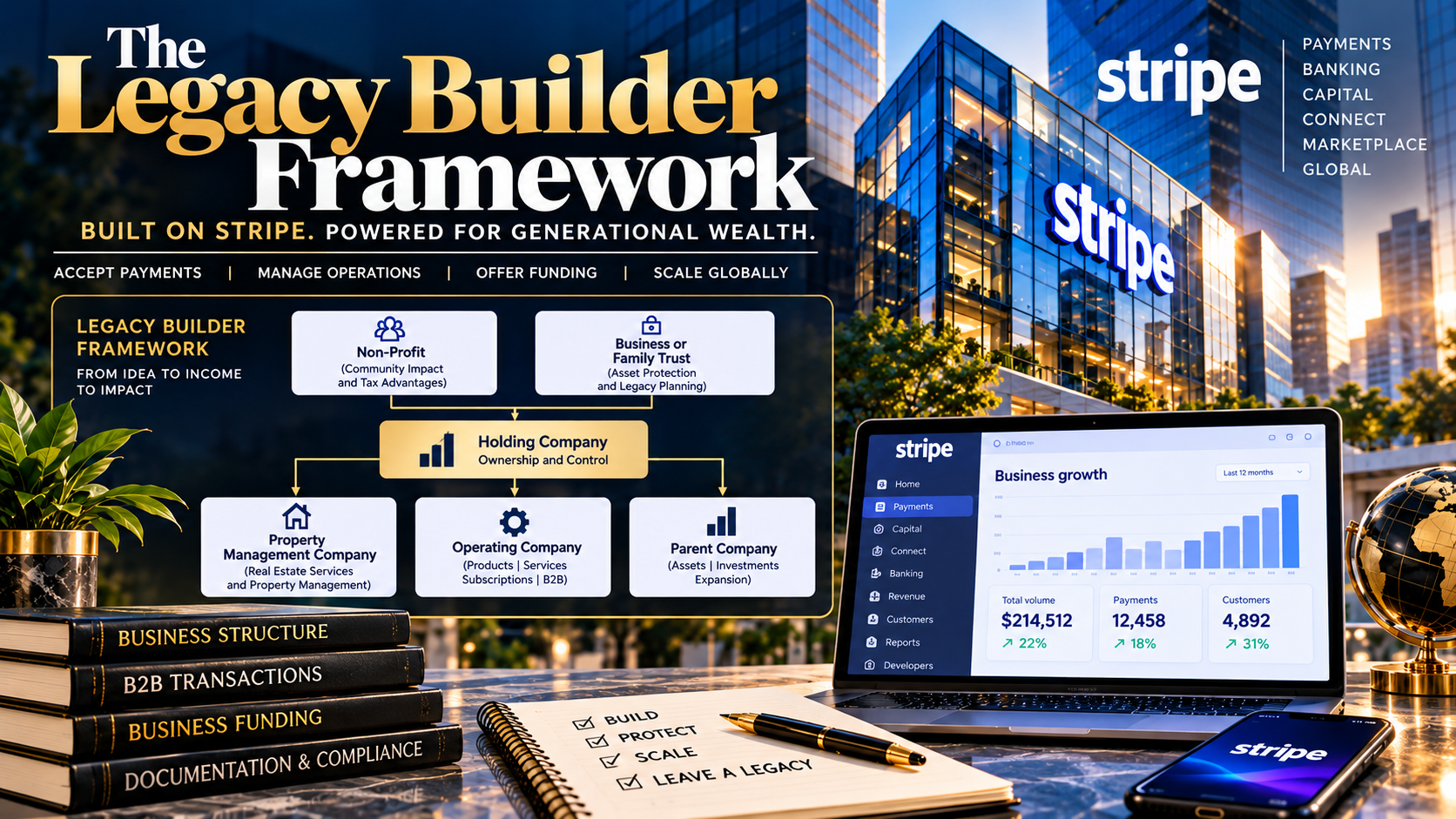
MAC Enterprise’s Legacy Builder framework emphasizes the separation of business functions, including operating, parent, holding, and property management companies. A nonprofit or trust may serve a separate, appropriate purpose depending on the circumstances.
1. The Legacy Builder Framework: More Than Opening Companies
When people hear about my Legacy Builder framework, some assume I’m simply teaching entrepreneurs to open multiple corporations.
That’s not the purpose.
I’m teaching entrepreneurs to understand the different functions that exist within a business enterprise and when it may make sense to organize those functions separately.
My framework addresses several important areas.
The Operating Company
This is the business that provides products or services to customers, employs workers when applicable, enters into customer contracts, and generates operating revenue.
The Parent Company
A parent company may own or oversee an operating company and perform legitimate administrative, strategic, or other management functions.
The Holding Company
A holding company may own shares in other companies, investments, or other assets. Its actual role depends on its structure and business purpose.
The Property Management Company
This is a particularly important distinction.
I teach a Property Management Company—not necessarily a Real Estate Investment Trust (REIT).
A property management company can perform legitimate property-related services, such as managing leases, coordinating maintenance, overseeing tenants, and administering real estate operations.
It does not automatically need to own real estate, and it does not become a REIT merely because it manages property.
A REIT is a specific legal and tax structure with separate qualification requirements.
Nonprofits and Trusts
My broader educational framework also discusses nonprofits and business or family trusts when appropriate.
These are not interchangeable with ordinary for-profit corporations. Nonprofits must operate for their legally authorized purposes, and trusts involve separate legal and tax considerations.
The objective is not to create unnecessary entities.
It’s to understand business structure, ownership, management, documentation, and long-term planning.
And those principles are worth comparing with corporate America.
2. Ford: Separate Financing Operations and a Stripe Partnership
Let’s start with Ford.
Most people know Ford as an automobile manufacturer.
But Ford’s business extends well beyond manufacturing and selling vehicles.
Ford Motor Credit Company operates as a separate financing business within the Ford corporate group.
Ford Credit provides financing services, including automotive retail and dealer financing, and its SEC filings describe transactions and relationships with Ford and its affiliates.
This demonstrates a basic corporate principle:
Different business functions can be conducted through separate legal entities within the same corporate family.
Now let’s examine a second receipt.
On January 17, 2022, Ford and Stripe announced a five-year agreement to support ecommerce and payment experiences for Ford customers and dealers.
Stripe described how its payment technology would help facilitate transactions involving Ford’s dealer network and other commercial applications.
Consider those two facts together.
Ford has a separately organized financing operation.
Ford also publicly announced a payments relationship with Stripe.
These are distinct relationships serving different purposes.
I am not suggesting Ford uses Stripe Capital to finance its operations or that Ford processes internal corporate transfers through Stripe.
Those claims are not established by the cited documents.
What is established is that Ford uses specialized corporate functions and modern payment infrastructure.

Ford Credit is a separately organized financing business, while Ford’s announced Stripe relationship concerns payment technology. These are two independently documented facts.
Read the original receipts:
3. Marriott: Why Brands, Management, and Property Ownership Matter
Now let’s talk about Marriott.
When someone books a Marriott hotel, they may assume Marriott owns the building, employs everyone working there, and operates the entire property.
But Marriott’s business model is more complex.
Marriott uses franchise and management agreements as important parts of its business.
Under these arrangements, hotel owners may pay fees for access to Marriott’s brands, reservation systems, and management services.
In many cases, the property owner is a separate business from Marriott.
That means several distinct economic functions may exist:
- Ownership of the hotel property
- Ownership and licensing of the hotel brand
- Management of hotel operations
- Provision of reservation and other business services
These functions may be governed by different contracts and performed by different parties.
This is exactly why I teach entrepreneurs to understand the distinction between owning assets, managing operations, and providing services.
But there is an important qualification.
Marriott’s business model does not mean every small business should create multiple entities or charge management fees without providing real services.
Fees must correspond to legitimate contractual arrangements.
Business relationships must be documented.
And related-party transactions require appropriate legal, tax, and accounting treatment.

Marriott illustrates how brand licensing, property ownership, and hotel management can be distinct business functions. The illustration is a simplified business-model comparison, not Marriott’s complete corporate ownership chart.
Read the original receipt:
4. McDonald’s: A Business Built on More Than Selling Hamburgers
McDonald’s is another example.
Most people think of restaurants and fast food.
But its financial statements show that rent and royalties are major components of its business.
According to McDonald’s 2025 annual filing, the company reported approximately $10.442 billion in franchised rent revenue and $6.018 billion in franchised royalty revenue.
Those are not hypothetical transactions.
They are reported business revenue streams associated with contractual franchise arrangements.
Think about the lesson.
A business can create economic value through more than direct product sales.
Property rights can generate rent.
Intellectual property can generate royalties.
Management services can generate contractual fees.
But the underlying rights, assets, and services must actually exist.
A legitimate business transaction is not the same as transferring money between accounts to make revenue appear larger.
That distinction matters.

Read the original receipt:
- McDonald’s 2025 Form 10-K
5. Amazon: Stripe Is Used by Major Enterprises
Another argument I’ve heard concerns Stripe itself.
Some people discuss Stripe as though it’s merely a tool for small online businesses.
But Stripe provides financial infrastructure for companies of many sizes.
Amazon is one example.
Stripe’s published Amazon customer story describes how the companies worked together on payment processing and international payment experiences.
The relationship includes Stripe payment products that help support commerce across markets.
Now, here’s where accuracy matters.
Amazon using Stripe Payments does not prove Amazon uses Stripe Capital.
Those are different products.
Stripe Payments facilitates commercial payments.
Stripe Capital provides financing options to eligible businesses and through participating platforms.
Understanding that distinction is essential.
The documented Amazon relationship establishes Stripe’s role in large-scale payment infrastructure—not a claim about Amazon borrowing through Stripe Capital.

Read the original receipt:
6. Stripe Capital: What FreshBooks, Jobber, and Brightwheel Reveal
Now let’s discuss business funding.
One of the things I consistently teach entrepreneurs is that business financing does not come from one single source or underwriting model.
Traditional banks, corporate financing products, revenue-based financing, commercial credit, and embedded financing can all operate differently.
Stripe Capital is one example of embedded business financing.
Financing offers are subject to eligibility, underwriting, applicable terms, and the particular product offered.
Let’s look at three businesses that demonstrate how Stripe Capital can be made available through software platforms.
FreshBooks
FreshBooks provides accounting, invoicing, and payment software for businesses.
Its business financing page identifies Stripe Capital among its available financing options.
The platform also describes financing products from other providers, so not every FreshBooks financing option should be described as Stripe Capital.
The larger point is that financing can be offered through software businesses already use to operate and manage their finances.
Source: FreshBooks Business Financing
Jobber
Jobber provides software for home service businesses.
Stripe published a customer case study describing Jobber’s integration of Stripe Capital.
This is especially relevant because home service businesses often need financing for equipment, staffing, supplies, and growth.
It illustrates how business software can connect eligible customers with financing products.
Source: Jobber’s Stripe customer story
Brightwheel
Brightwheel provides software for childcare and early education businesses.
Stripe has also documented Brightwheel’s use of Stripe Capital to offer financing to eligible businesses on its platform.
This expands the conversation beyond ecommerce.
We’re talking about childcare providers, service businesses, and companies using accounting software.
Different industries can access financing through different channels, subject to their qualifications and available offers.

FreshBooks, Jobber, and Brightwheel illustrate how Stripe Capital-related financing can be integrated into business software. Financing is subject to eligibility and applicable terms.
Read the original receipts:
7. What About Business-to-Business Transactions?
This is where I want entrepreneurs to pay close attention.
Business-to-business transactions are normal commercial activities.
One company may provide another company with administrative services, management services, property management, equipment, intellectual property rights, or other legitimate business benefits.
Sometimes those businesses are independently owned.
Sometimes they share common ownership.
Common ownership does not automatically make a transaction improper.
But common ownership also does not automatically make a transaction legitimate.
The substance of the transaction matters.
For example, a property management company may provide actual property management services under a written agreement.
An operating company may pay a legitimate management fee to a company that genuinely performs contracted services.
A company may lease property from another company under commercially supportable terms.
Those arrangements require appropriate documentation, accounting, tax treatment, and compliance with applicable laws.
And when companies share ownership, their transactions may be subject to additional related-party rules.
What I do not teach is creating fake invoices, fictitious services, or artificial payment volume to manipulate financing eligibility.
That’s not responsible business education.
And it isn’t what entrepreneurs should take away from corporate America.
The lesson is to establish genuine business functions, maintain accurate records, and understand the purpose of every transaction.
8. Why Business Structure and Funding Must Be Discussed Separately
Another misconception is that opening an LLC, obtaining an EIN, or establishing a corporation automatically qualifies someone for business financing.
It doesn’t.
Financing providers evaluate businesses using their own underwriting criteria.
Depending on the product, those criteria may include business revenue, payment history, cash flow, financial performance, ownership information, credit history, and other risk factors.
Some products require personal guarantees.
Others may be structured differently.
But no personal guarantee and no personal credit check are not the same thing.
And the absence of a personal guarantee in one transaction doesn’t establish that every financing offer from that provider has the same terms.
I teach entrepreneurs to understand those differences before signing financing agreements.
Business structure matters.
Business documentation matters.
Cash flow matters.
Contracts matter.
And the actual terms of the financing matter.
9. The Real Lesson Corporate America Teaches Us
After studying these companies, here’s what I want entrepreneurs to understand.
Ford demonstrates the separation of automotive and financing operations, while its Stripe partnership demonstrates the use of external payment infrastructure.
Marriott demonstrates the economic significance of brand licensing and hotel management.
McDonald’s demonstrates how rent and royalties can be substantial contractual revenue streams.
Amazon demonstrates Stripe’s role in large-scale payments.
FreshBooks, Jobber, and Brightwheel demonstrate how financing can be integrated into software used by businesses across different industries.
These are not identical business models.
And none of them proves that every entrepreneur needs the same corporate structure.
But together, they demonstrate an important principle:
Successful business systems are built around identifiable functions, documented relationships, valuable assets, financial infrastructure, and sound management.
That’s what I want entrepreneurs to study.
Not just how to open a company.
But how to operate one.
How to protect legitimate business interests.
How to manage assets.
How to understand financing.
And how to build something that can survive beyond the founder.
10. Let’s Address the Myths: What Entrepreneurs Are Being Told vs. What the Evidence Shows
I’ve spent this article showing you documented examples from Ford, Marriott, McDonald’s, Amazon, FreshBooks, Jobber, and Brightwheel.
Now let’s address some of the statements I’ve heard about corporate structures, business-to-business transactions, and business funding.
Because there’s a difference between questioning a strategy and declaring that something doesn’t work without examining the evidence.
MYTH #1: “You don’t need multiple corporations to operate a business.”
THE FACTS: You don’t necessarily need multiple corporations. But separate legal entities can serve legitimate business purposes.
Ford operates a separately organized financing subsidiary.
Other companies establish subsidiaries for specialized business functions, investments, or operations.
The question isn’t whether every entrepreneur needs multiple corporations.
The question is whether each corporation serves a legitimate, documented business purpose.
That’s what my Legacy Builder framework is designed to teach.
MYTH #2: “Companies with the same owner shouldn’t do business with each other.”
THE FACTS: Common ownership does not automatically prohibit legitimate transactions between separate companies.
Companies under common ownership can enter into management agreements, service contracts, leases, and licensing arrangements.
But those transactions must involve genuine economic activity, appropriate pricing, accurate accounting, and compliance with applicable laws.
Related-party transactions also may require additional tax documentation, disclosures, or adjustments.
Shared ownership doesn’t automatically make a transaction improper.
MYTH #3: “Business-to-business transactions are just moving money around.”
THE FACTS: Legitimate B2B transactions involve real products, services, rights, or other business benefits.
A property management company may charge for property management services it actually performs.
A business may pay rent for property it legitimately occupies.
A company may license intellectual property under a valid commercial agreement.
McDonald’s publicly reports billions of dollars in franchise rent and royalty revenue.
Marriott’s business model includes documented franchise and management arrangements.
These examples establish the legitimacy of those categories of commercial activity—not permission to create artificial transactions.
The difference is whether real economic value is being exchanged.
MYTH #4: “Stripe is only for small online businesses.”
THE FACTS: Stripe provides financial infrastructure to businesses of different sizes, including major enterprises.
Amazon and Ford have publicly documented relationships with Stripe involving payment technology.
Stripe also provides tools for platforms and software businesses.
Stripe is not simply a payment button on a website.
But remember: a company’s use of Stripe Payments does not establish that it uses Stripe Capital.
MYTH #5: “You must have a certain personal credit score to qualify for every type of business funding.”
THE FACTS: Different financing products use different underwriting criteria.
Traditional business credit products may place significant weight on personal credit.
Other financing products may evaluate business payment activity, revenue, cash flow, or other financial information.
Stripe Capital is one example of a program that uses business-related information when determining financing eligibility.
That does not mean personal credit is never considered, that every applicant qualifies, or that every product is available without a personal guarantee.
There is no single credit-score rule that applies to every business financing product.
MYTH #6: “An LLC and an EIN are all you need to get business funding.”
THE FACTS: Forming an LLC and obtaining an EIN do not guarantee financing.
Lenders and financing providers may evaluate revenue, operating history, cash flow, payment activity, financial records, credit, and other factors.
A business needs more than registration paperwork to demonstrate creditworthiness.
An EIN identifies a business for tax purposes.
It is not an approval letter for financing.
MYTH #7: “A C-Corporation automatically qualifies for funding without a personal guarantee.”
THE FACTS: A C-Corporation is a separate legal entity, but its corporate status does not automatically eliminate personal guarantee requirements.
Some financing arrangements may be available without a personal guarantee, depending on the lender, product, and borrower.
Others require one.
A lender can request a personal guarantee from the owner of a corporation just as it can from the owner of an LLC.
The actual financing agreement determines the obligation—not the letters at the end of the business name.
MYTH #8: “A holding company and a property management company are the same thing.”
THE FACTS: They can perform different functions.
A holding company generally holds ownership interests or other assets.
A property management company may manage properties, coordinate maintenance, administer leases, and perform contracted real estate services.
And let me clarify something important about my own framework:
I teach a Property Management Company. I am not saying every entrepreneur needs a REIT.
A Real Estate Investment Trust is a specialized structure subject to distinct tax and legal requirements.
Those distinctions matter.
MYTH #9: “Processing payments between your own companies automatically qualifies you for Stripe Capital.”
THE FACTS: Absolutely not.
Stripe Capital financing is subject to underwriting, eligibility, product requirements, and applicable terms.
Simply transferring money between companies or generating artificial payment volume does not create legitimate business revenue.
Payments must represent real, authorized commercial activity and comply with Stripe’s rules.
A legitimate B2B transaction is not a guaranteed path to financing.
No entrepreneur should manufacture transactions to influence a funding decision.
MYTH #10: “If a business strategy works, every company should use it.”
THE FACTS: The right business structure depends on the business.
A corporation operating nationwide may need subsidiaries for reasons that don’t apply to a small local service provider.
A business without real estate may have no reason to establish a property management company.
A company without separately valuable intellectual property may have no reason to create a licensing arrangement.
And a nonprofit should only be established for a legitimate nonprofit purpose.
The objective is not to imitate corporate America blindly.
It’s to understand the principles and apply them where appropriate.
11. My Final Message: The Receipts Are Public. The Responsibility to Learn Is Ours.
Here’s what I want every entrepreneur to take away from this article.
Don’t confuse confidence with knowledge.
Don’t confuse popularity with expertise.
And don’t assume that because someone speaks loudly about a business strategy, they’ve examined the contracts, corporate filings, financial disclosures, or laws behind it.
I understand that some people will disagree with what I teach.
That’s fine.
Business education should be questioned. Corporate structures should be examined. Financing claims should be verified.
And entrepreneurs should never blindly follow anyone—including me.
But if we’re going to challenge business practices, let’s begin with documented facts.
Read Ford’s filings.
Study Marriott’s business model.
Examine McDonald’s reported rent and royalty revenue.
Review Amazon’s Stripe customer story.
Explore how FreshBooks, Jobber, and Brightwheel offer financing through business software.
The evidence is publicly available.
But understand this: just because a major corporation uses a particular business strategy doesn’t automatically mean that strategy is appropriate for every entrepreneur.
My Legacy Builder framework isn’t a promise of automatic funding, guaranteed tax savings, or permission to create artificial business transactions.
It’s about helping entrepreneurs understand business structure, ownership, operations, financial relationships, and long-term planning.
My goal has never been to teach entrepreneurs how to simply open companies.
My goal is to teach them how to understand the businesses they’re building.
You don’t have to agree with everything I teach.
But before you dismiss a business principle, study the evidence.
Because in business, the loudest opinion isn’t necessarily the most informed one.
Opinions may attract attention.
But documentation establishes what can actually be proven.
You don’t have to believe me. Read the receipts.
PROVE IT!


