
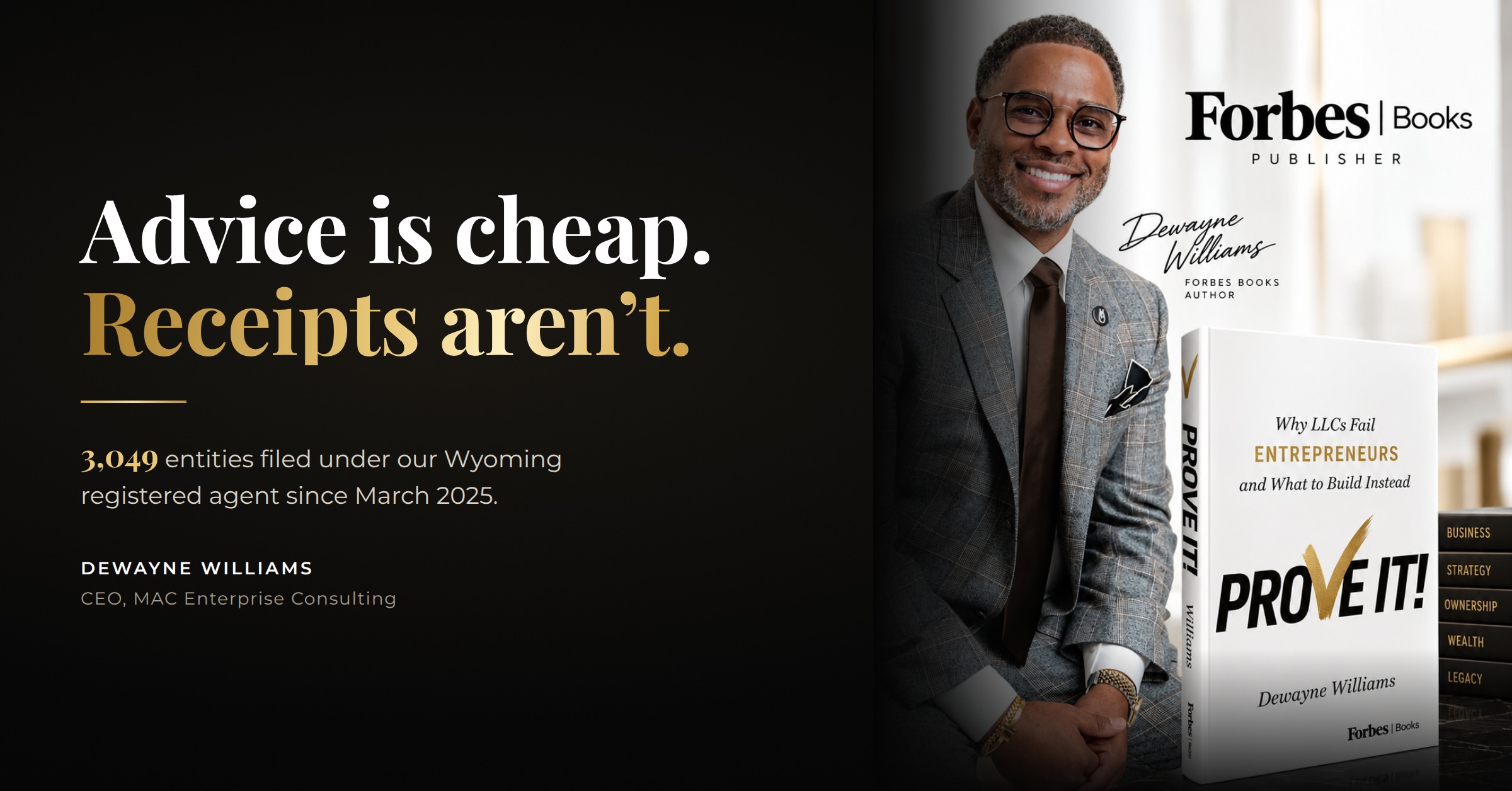
In March 2025, we opened an office in Wyoming.
It wasn’t a flashy decision.
There was no press release.
It was a calculated bet that entrepreneurs across the country needed a better foundation for how they form and structure their companies—and that we could build the infrastructure to serve them.
About eighteen months later, the Wyoming Secretary of State lists 3,049 entities filed under MAC Enterprise Registered Agent Services Inc.

I’m not sharing that number because it’s the most impressive figure in business. It isn’t.
I’m sharing it because it’s verifiable.
It’s public record. Anyone can check it.
And in a market overflowing with business advice, verifiable is becoming increasingly rare.
The Credibility Problem Nobody Talks About
There has never been more business advice available—or less accountability for it.
Today, someone can build a large audience teaching entrepreneurship before they’ve built a successful business of their own.
The content can be polished.
The confidence can be convincing.
The information can even sound right.
But where are the results?
That’s why my standard has always been simple:
Before you follow someone’s advice, look at what they’ve built.
Have they made the decisions they’re recommending?
Have they taken the risks they’re asking you to take?
Have they actually implemented the strategies they’re teaching?
And most importantly:
Did those decisions produce results that can be verified?
I hold myself to that same standard.
It’s the reason my book is called PROVE IT!
I don’t believe you should follow me simply because I say something confidently.
Look at the receipts.
Why the LLC Can Become a Ceiling
Here’s the idea at the center of my work, and it makes some people uncomfortable:
For many entrepreneurs, the LLC has become the default—not necessarily because it is the best structure for what they are trying to build, but because it is the structure they were told to choose.
To understand my position, you first have to understand why the LLC exists.
The LLC was developed as a hybrid business structure—combining limited-liability characteristics associated with corporations with more flexible tax treatment. It solved a real problem and can serve a legitimate purpose.
But somewhere along the way, that history got reduced to a much simpler message for entrepreneurs:
“Get an LLC. It’s cheap, it’s easy, and it protects you.”
I believe that advice is incomplete.
First, let’s talk about “cheap.”
People often talk as though forming an LLC is inherently cheaper than forming a corporation. But at the Secretary of State level, that isn’t necessarily true. In many states, the filing fees are the same or comparable.
So if the state charges you roughly the same amount to register an LLC or a corporation, cost alone shouldn’t determine the structure of the business you hope to spend the next 10, 20, or 30 years building.
Then there’s the word “protection.”
Yes, an LLC can provide limited liability. But simply putting “LLC” behind a business name does not create an impenetrable wall around everything you own. Liability protection depends on many factors, including how the business is operated, whether personal and business affairs are properly separated, contracts and guarantees you sign, applicable law, and the specific facts surrounding a claim.
And corporations provide limited liability too.
So the conversation shouldn’t simply be:
“Will an LLC protect me?”
The better question is:
“What am I trying to build, and which structure best supports where I want to go?”
That changes the conversation completely.
Are you trying to create a side business that provides additional income?
Are you trying to build a company that can retain capital and reinvest aggressively?
Do you eventually want outside investors?
Do you want to build multiple companies?
Do you want to separate operating businesses from other assets?
Are you thinking about succession?
Are you thinking about what happens to these companies when you are no longer here?
Are you building income—or are you building an institution?
Those questions matter more to me than simply asking which entity is easiest to open.
The Tax Conversation Matters Too
Depending on the number of owners and elections made, an LLC can be treated for federal tax purposes as a disregarded entity, partnership, S Corporation, or C Corporation.
That distinction matters.
Under common pass-through classifications, business income generally flows through to the owner or owners and is reported on their individual tax returns. Depending on the classification and circumstances, owners can owe tax on their share of business income even when some of that cash remains inside the business.
A C Corporation works differently.
The corporation is a separate federal taxpayer. Under current federal law, a C Corporation generally pays a 21% federal corporate income tax rate on its taxable income.
That does not mean a C Corporation automatically creates a 21% total tax rate for every owner.
If corporate earnings are later distributed as taxable dividends, another level of taxation may apply. Compensation, distributions, retained earnings, accumulated earnings rules, state taxes, and many other factors can affect the actual result.
That’s exactly why I reject one-size-fits-all business advice.
You cannot determine the right structure by looking at one tax rate.
You have to look at what the entrepreneur is actually trying to accomplish.
Structure Can Affect More Than Taxes
Taxes are only one piece of the conversation.
Structure can also matter when you begin thinking about raising capital, issuing ownership, bringing in investors, retaining earnings, acquiring other companies, separating business functions, succession planning, estate planning, and eventually transferring or selling what you have built.
Institutional investors and venture capital investors commonly use and prefer C Corporation structures.
There are also federal tax provisions that are specifically tied to qualifying C Corporation stock.
One of the most significant is Section 1202, commonly known as Qualified Small Business Stock or QSBS.
When all statutory requirements are satisfied, qualifying shareholders may potentially exclude some or all eligible gain from federal income tax when qualifying stock is eventually sold.
That benefit is not simply available because someone owns an LLC.
But even that isn’t my reason for saying everyone should form a C Corporation.
Because I’m not saying that.
I Am Not Saying Every LLC Is Wrong
There are situations where an LLC can make sense.
There are situations where an S Corporation tax election can make sense.
There are situations where a partnership structure can make sense.
There are situations where a C Corporation can make sense.
And there are situations where an entrepreneur may need multiple entities serving completely different purposes.
The structure should follow the strategy.
My disagreement is with the idea that every entrepreneur should automatically start with an LLC simply because somebody told them it was cheap, easy, and would “protect” them.
I think entrepreneurs deserve a deeper conversation than that.
If you are trying to build something substantial, ask better questions.
Don’t just ask:
“What is the easiest entity to start?”
Ask:
What am I trying to build?
How will this company make money?
Where will profits go?
Will I need outside capital?
Will I eventually own multiple companies?
Where should valuable assets be held?
How do I separate risk?
How will ownership eventually transfer?
What happens to everything I built when I’m gone?
That is the conversation behind the Legacy Builder.
And it’s the conversation behind PROVE IT!
My position isn’t that an LLC can never work.
My position is that “everybody told me to get an LLC” is not a business strategy.
Your entity should be chosen based on what you are trying to build—not because it was the default option someone put in front of you.
Decisions Compound
Our Wyoming decision didn’t happen in isolation.
It came from years of building businesses, restructuring companies, making mistakes, learning expensive lessons, and applying the same principles to my own companies that I teach today.
Those principles eventually became part of our Legacy Builder program.
One thing entrepreneurship has taught me is that good decisions compound.
One structural decision creates capacity for another.
One relationship creates another opportunity.
One investment creates infrastructure.
Execution gives you information that planning alone never could.
And every legitimate result you can point to makes the next opportunity easier to earn.
Not every decision I’ve made has worked.
I’ve made mistakes.
I’ve spent money I probably wouldn’t spend again.
I’ve had strategies fail.
And I’ve had people tell me plainly that my approach was wrong.
Some criticism made me sharper.
Some made me rethink decisions.
And I’m grateful for that.
But eventually, there comes a point when opinions have to meet results.
One Door Opens Another
When we went to Wyoming in March 2025, I wasn’t thinking about writing a book.
We were trying to solve a business problem.
But that’s one of the things I love about entrepreneurship:
One door opens another.
A decision you make today may create an opportunity you cannot see yet.
I’m humbled to share that I’m now a Forbes Books author, and my upcoming book is called:
PROVE IT!
Why LLCs Fail Entrepreneurs and What to Build Instead
The book is being published by Forbes Books and is available for pre-order.

The book lays out the framework behind what I’ve spent years building and teaching: why I believe the default structure fails many entrepreneurs as they grow, what they should consider building instead, and why business structure should be treated as a long-term business and wealth decision—not simply a filing with the Secretary of State.
But there’s another reason I called the book PROVE IT!
I want people to challenge the ideas.
If you’ve agreed with my approach, I think you’ll find the book useful.
If you’ve disagreed with me, I especially want you to read it.
Then tell me where I’m wrong.
But bring receipts.
Not just a Google search.
Not just a screenshot of an IRS webpage.
Not just something somebody said on social media.
Show me what you built.
Show me how you structured it.
Show me what happened when you implemented the strategy.
Show me the doors that structure opened.
Show me the results.
And then let’s have the conversation.
Because that’s what PROVE IT! means to me.
I’m willing to put my own work under the same microscope.
Results Should Speak for Themselves
My goal has never been to become the loudest voice in entrepreneurship.
It’s to build something that eventually doesn’t require a long explanation.
When results are real, you shouldn’t have to oversell them.
State the facts.
Show the documentation.
Let people check your work.
In March 2025, we made a decision to establish ourselves in Wyoming.
Approximately eighteen months later, the Wyoming Secretary of State lists 3,049 entities filed under MAC Enterprise Registered Agent Services Inc.
That doesn’t mean we know everything.
It doesn’t mean every decision we’ve ever made was right.
And it certainly doesn’t mean everyone has to agree with our philosophy.
It means we’re building.
We’re implementing.
We’re learning.
And we’re willing to show the receipts.
That’s the kind of business I want every entrepreneur we work with to build:
A business that holds up when somebody asks, “Can you prove it?”
Where Do You Start?
Whether you’re running your first company or overseeing several, I want you to ask yourself one question:
Is your business structured for where you’re going—or for where you started?
If you own one company, that may mean reevaluating whether your current entity and tax structure still support your goals.
If you already own multiple businesses, the conversation becomes bigger.
How do those companies relate to one another?
Where are your assets held?
Where does the operating risk live?
What happens to everything you’ve built if something happens to you?
What does succession look like?
What does legacy look like?
Those are the conversations we believe entrepreneurs should be having.
If You Want to Learn the Framework
Start with our Journey to Success Masterclass.
It walks entrepreneurs through the framework we use to think about building, structuring, protecting, and maintaining a business.
If You Already Have an LLC
If you believe your LLC may have become a ceiling, talk with our team about whether converting or restructuring into a C Corporation makes sense for your specific circumstances.
If You’re Ready to Build the Complete Structure
Explore our Legacy Builder program.
Legacy Builder is designed for entrepreneurs who want to think beyond simply owning a company and begin building an intentional business structure around growth, protection, and legacy.
And If You Want the Full Philosophy Behind It
Pre-order PROVE IT! Why LLCs Fail Entrepreneurs and What to Build Instead.
The book is available for pre-order through Amazon, Barnes & Noble, Books-A-Million, Hudson Booksellers, Target, Walmart, and MAC Enterprise Consulting.
You don’t have to believe what I teach.
Watch what we build.
Check the receipts.
And make us prove it.
Start Your Journey to Success
Visit MAC Enterprise Consulting to learn more about our Masterclass, business formation services, C Corporation conversions, and Legacy Builder program.
About the Author
Dewayne Williams is the CEO of MAC Enterprise Consulting Inc., a Forbes Books author, a regular contributor on Forbes.com and Entrepreneur.com, and a member of the Entrepreneur Leadership Network.
Disclaimer: This article is provided for general educational and informational purposes only and is not intended as legal, tax, accounting, investment, or financial advice. Business structures and tax consequences vary based on individual circumstances. Consult qualified legal, tax, and financial professionals regarding your specific situation.


