
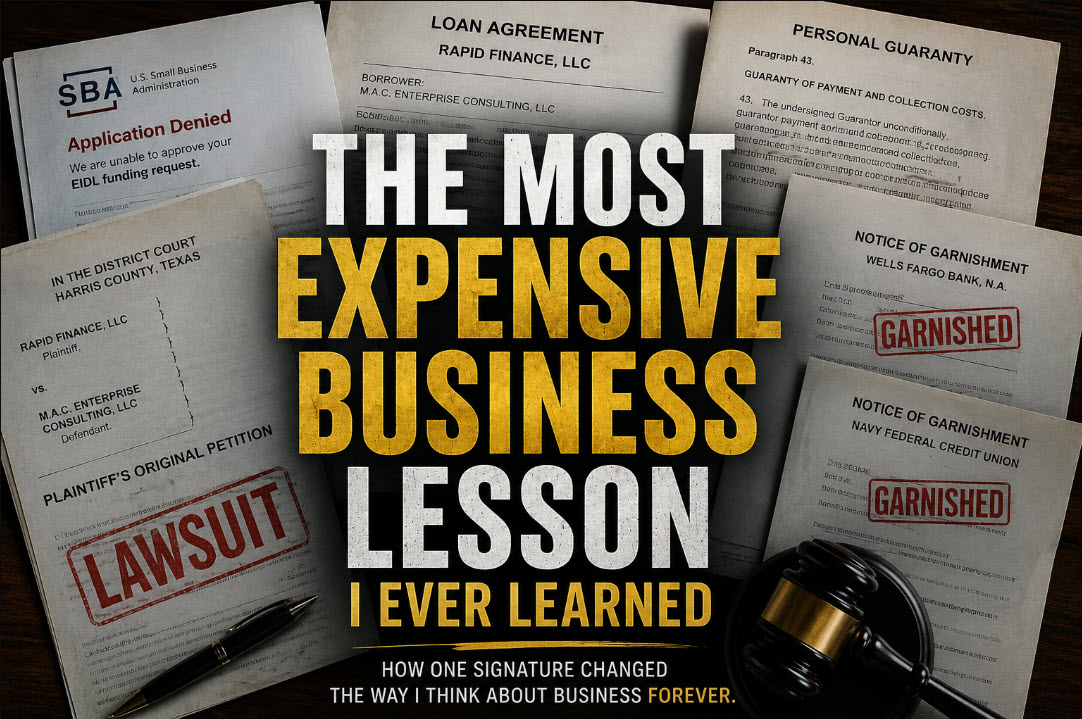
How one signature, one lawsuit, and one painful lesson changed the way I think about business forever.

There are moments in life that split your story into two chapters. Before — and after.
For me, that moment wasn’t the day I formed my LLC.
It wasn’t the day I got approved for funding.
It wasn’t even the day I signed the loan documents.
It was years later — when I realized one signature had followed me into my personal life.
Today I teach entrepreneurs why I believe business structure matters. Some people think it’s because I hate LLCs. I don’t.
Some people think it’s because I sell C corporations.
I don’t teach C corporations because they’re trendy.
I teach them because I lived through something I hope nobody else ever has to.
Everything you’re about to read happened to me.
Every document.
Every court filing.
Every signature.
Every email.
Every loan agreement.
Every garnishment attempt.
I’ve redacted my personal information.
Nothing else has been changed.
It didn’t start with a merchant cash advance. It started with COVID.
When COVID hit, my business was hurting.
Like millions of entrepreneurs, I did exactly what we were all told to do: apply for SBA assistance.
I qualified — or at least I believed I did.
My credit exceeded the SBA’s published minimum requirements.
My businesses existed before the pandemic.
I submitted tax returns, IRS forms, contracts, invoices, insurance — everything they asked for.
Then I waited.
And waited.
And waited.

My Experian file: the SBA (“US SM BUS ADMIN ODA — Federal Government”) pulled my credit on November 26, 2021.
Instead of funding, I found myself fighting.
I emailed.
I called.
I submitted reconsideration letters.
I contacted supervisors.
I contacted my congresswoman.
I contacted my senator.
I contacted anyone who would listen.
On the privacy form for Congresswoman Lizzie Fletcher, I wrote out exactly what was happening:

My Privacy Authorization Form to Congresswoman Lizzie Fletcher — January 31, 2022. (Personal details below the statement were cropped out.)
| In my own words, to my congresswoman “My EIDL application has been at a standstill for quite some time. I contacted the SBA, and I continue to be told they are waiting on IRS tax transcripts… the IRS has two years of tax returns sitting there… Any help you can provide will be greatly appreciated.” |
I filed the same kind of release with the office of U.S. Senator John Cornyn — naming the SBA and the EIDL program as the source of my difficulty.

General Privacy Release Form to U.S. Senator John Cornyn. (Cropped above all personal information.)
I wasn’t looking for special treatment.
I was looking for someone to explain why I qualified on paper but couldn’t get answers.
Then, on February 26, 2022, the answer finally came — a decline letter.

The SBA decline letter — February 26, 2022. Reason given: “Unsatisfactory credit history.” (Home address and application number redacted.)
The reason: “unsatisfactory credit history.”
No detailed explanation.
No specific score or item identified.
Just a denial — while my business was running out of time.

As you can see from the email above, my credit score at the time met the SBA’s published minimum credit requirement, which is why the denial left me confused
Still, Bills don’t stop because the government moves slowly.
Payroll doesn’t stop.
Rent doesn’t stop.
Insurance doesn’t stop.
Employees don’t stop needing paychecks.
Life doesn’t stop.
So eventually, I did what thousands of business owners do. I looked elsewhere.
That’s when the merchant cash advances entered my life — not because I wanted them, but because I felt I had no better option.
And it wasn’t one advance.
By early 2022, the SBA’s own Schedule of Liabilities laid out how many I was already carrying:

My SBA Schedule of Liabilities, signed March 21, 2022. Itria, National Funding, and Rapid Finance are all marked “DEL” — delinquent.
Look at the status column.
Three of those advances were already delinquent.
This wasn’t one isolated decision.
It was a pattern that formed under pressure, during a specific window, for a specific reason.
This Is Where Everything Began to Change
When people look at these documents today, they usually focus on the numbers.
I don’t.
I remember the pressure.
I remember wondering how I was going to keep my business alive.
I remember making decisions I never imagined I’d have to make.
When you’re trying to survive, you aren’t thinking about what might happen four years from now.
You’re thinking about tomorrow.
Nobody ever warned me about the fine print.
One of those advances was a $45,000 deal with Small Business Financial Solutions, LLC — the lender behind Rapid Finance.
The borrower was my company, M.A.C. Enterprise Consulting Agency, LLC.

The loan agreement. Borrower: M.A.C. Enterprise Consulting Agency, LLC. Amount: $45,000. Total payback: $64,350.
People love talking about getting approved.
Nobody talks about what happens after you’re approved.
And nobody tells you this:
The most expensive signature isn’t the borrower signature.
It’s the guarantor signature.
On the signature page, my name appears twice — once as the Borrower for the LLC, and once as the personal Guarantor.
Two different legal capacities.
Both signed by me.
Both dated January 28, 2022.

The signature page. Left: Borrower (the LLC). Right: Guarantor (me, personally).
At the time, that word meant almost nothing to me.
Today it means everything.
Here is what I actually signed:

Paragraph 43 — the guaranty.
| From the guaranty I signed “This guarantee is unlimited, absolute and without condition…” “…IN NO WAY CONDITIONED OR CONTINGENT UPON ANY ATTEMPT TO COLLECT FROM THE BORROWER…” |
Unlimited.
Absolute.
Without condition.
And the lender didn’t have to try the LLC first.
I even signed the same-day amendment as both Borrower and Guarantor.

The amendment, signed the same day — Borrower and Guarantor, both Dewayne Williams.
That one signature changed my life.
This Is Why I’m So Passionate
People ask me every day why I spend so much time talking about business structure.
Some people think I’m obsessed with C corporations.
Some people think I’m just trying to sell something.
They’re wrong.
I don’t teach this because I won an argument.
I teach it because I lived the consequences.
This isn’t a Google search.
This isn’t a YouTube video.
This isn’t something I copied from someone else.
These are my documents.
My signatures.
My lawsuits.
My life.
I don’t care if people disagree with me.
I care that entrepreneurs understand what they’re signing before it’s too late.
Because I know what it’s like to learn after the ink has already dried.
Then came the lawsuit.
Business changed.
Cash flow changed.
Like thousands of owners before me, I struggled.
Then came the lawsuit — and the judgment.
| From the Maryland court record DEFAULT JUDGMENT — $53,600.00 Entered July 16, 2025 against Dewayne Williams, M.A.C. Enterprise Consulting Agency, LLC, and Residential Holding Services, LLC. Circuit Court for Montgomery County, Maryland. |
That is when I finally understood what a personal guaranty really meant.
Most people think the story ends at the judgment.
It doesn’t.
Then they came for my bank accounts.
Not the LLC’s accounts.
Mine.
On May 12, 2026—more than four years after I signed those documents—I was reading yet another legal filing with my name on it.
Four years later…
I’m still dealing with it.
That realization hit me harder than the lawsuit itself.
When I signed those documents in January 2022, I believed I was signing paperwork to help keep my business operating.
I never imagined that more than four years later, I’d still be opening court filings, reading garnishment papers, and seeing my own name in legal documents.

Navy Federal’s answer: “$0.00 available for attachment” across three of my personal accounts.
Navy Federal answered a writ of garnishment against my personal accounts.
The response showed $0.00 available for attachment across three personal accounts.
The court later dismissed the Wells Fargo garnishment writs—one against me personally and one against my LLC.

Court order: judgment for the garnishee (Wells Fargo), writ dismissed — July 1, 2026.

The same result on the LLC’s account — that writ, dismissed.
Here’s what people get wrong. On the docket these show up as “Order – Termination.”
That does not mean the debt is gone.
It means one garnishment attempt ended.
The judgment stays alive.
The case still reads “Reopened.”
| A terminated garnishment is not a satisfied judgment. Think of it like fishing. One line comes up empty. That doesn’t stop them from casting another — as long as the judgment is still on the books. |
This isn’t why I started teaching C corporations and the importance of complete separation.
People assume I woke up one morning and decided I liked C corporations more.
That isn’t what happened.
The lawsuit forced me to think differently.
The collections forced me to think differently.
The garnishments forced me to think differently.
I started asking questions I had never asked before.
How do America’s largest companies borrow money?
How do corporations own assets?
How do companies survive for generations?
How do wealthy families structure ownership?
How do businesses buy vehicles?
Why are some companies able to build credit that isn’t tied to the owner’s Social Security number?
I wasn’t looking for a better entity. I was looking for a better future.
And let me be honest: the C corporation didn’t magically solve every problem.
A corporation can still be sued, and its own assets can still be reached if the corporation itself is liable.
What it did was force me to stop thinking like an LLC owner and start studying how corporations actually operate — how liability, ownership, and credit really work.
That curiosity changed my life.
Not the lawsuit.
Not the LLC.
Not the guaranty.
The transformation.
I don’t care if you disagree with me.
Experience Changed My Perspective
People are free to disagree with my conclusions.
Healthy debate is part of business.
But nobody can debate my experience.
Nobody lived these documents except me.
Nobody dealt with these lawsuits except me.
Nobody received these garnishment papers except me.
Experience became my greatest teacher.
That’s why I continue studying.
That’s why I continue reading statutes.
That’s why I continue questioning what I once believed.
And that’s why I continue teaching.
Not because I think I know everything.
But because I never want another entrepreneur to discover these lessons the same way I did.
Seriously.
You don’t have to agree with me.
You don’t have to buy from me.
You don’t even have to like me.
But answer one question honestly.
| If your business failed tomorrow, are you 100% certain that nobody could reach your personal assets because of something you’ve already signed? |
Not what someone on TikTok told you.
Not what your friend told you.
Not what you hope is true.
What does YOUR paperwork actually say?
Have you read it?
Every page?
Every signature?
Every guaranty?
Because I didn’t. And I paid for that mistake—and I’m still paying for that mistake today.
More than four years later… the judgment is still there.
The court filings are still there.
Collection efforts are still continuing.
Every new legal document reminds me that one signature can have consequences long after the day you sign it.
I can’t change the signature I made in January of 2022.
But I can make sure someone else understands theirs before they sign.
That’s why I teach — not because I’m trying to win an argument, but because I already lived the consequences.
If my experience keeps one entrepreneur from blindly signing a personal guaranty, then every painful document in this article served a purpose.
And maybe that’s what this entire journey was really about.
The full timeline — from the first SBA application to today.
| Date | What happened |
| March 2020 | COVID disrupts the business. I begin pursuing SBA Economic Injury Disaster Loan (EIDL) relief. |
| Nov 9, 2021 | Email the SBA reconsideration team: two separate businesses, operating before the pandemic, credit scores of 648 / 701 / 723. |
| Nov 26, 2021 | SBA credit inquiry appears on my Experian report. |
| Jan 28, 2022 | Sign the $45,000 Rapid Finance deal — LLC as borrower, me personally as guarantor. |
| Jan 31, 2022 | Sign a privacy release authorizing Rep. Lizzie Fletcher’s office to intervene on the stalled EIDL application. |
| Feb 26, 2022 | SBA issues a decline letter citing “unsatisfactory credit history.” |
| Mar 7, 2022 | Sign a privacy release authorizing Sen. John Cornyn’s office to look into the SBA EIDL issue. |
| Mar 20–21, 2022 | SBA Schedule of Liabilities documents four merchant cash advances already stacked — three marked delinquent. |
| Sep 3, 2024 | Lawsuit filed in the Circuit Court for Montgomery County, Maryland. |
| Jul 16, 2025 | $53,600 default judgment entered against me and the entities. |
| Oct 2025 – Feb 2026 | Multiple garnishment requests and writs against personal and business accounts. |
| May 12, 2026 | Navy Federal reports $0.00 available for attachment across three personal accounts. |
| Jul 1 / Jul 8, 2026 | Wells Fargo garnishment writs dismissed — the underlying judgment was not shown as satisfied. |
| 2026 (ongoing) | The judgment remains on the docket. The case still reads “Reopened.” |
THIS IS WHY I TELL ENTREPRENEURS: Don’t wait until there’s a lawsuit or collection effort to think about business structure and complete separation. By the time a creditor is pursuing collection, your options may be very different from what they were before the debt arose.
On May 12, 2026—more than four years after I signed those documents—they were still attempting to garnish money from my personal bank accounts.
So, if your LLC owes a debt, if you co-signed an agreement, or if you personally guaranteed an obligation, you may not be as protected as you think.
Today, my C corporation is still operating. It is a separate legal entity with its own legal identity. My experience is what led me to study the importance of complete separation long before problems arise.
A note on what this is — and isn’t.
This is my personal experience and general information, not legal or financial advice, and it is not a statement about anyone else’s case. The documents shown are my own records and the public court file, with personal identifiers redacted. If you’re facing a judgment or a guaranty question, talk to a licensed attorney in your state.


