
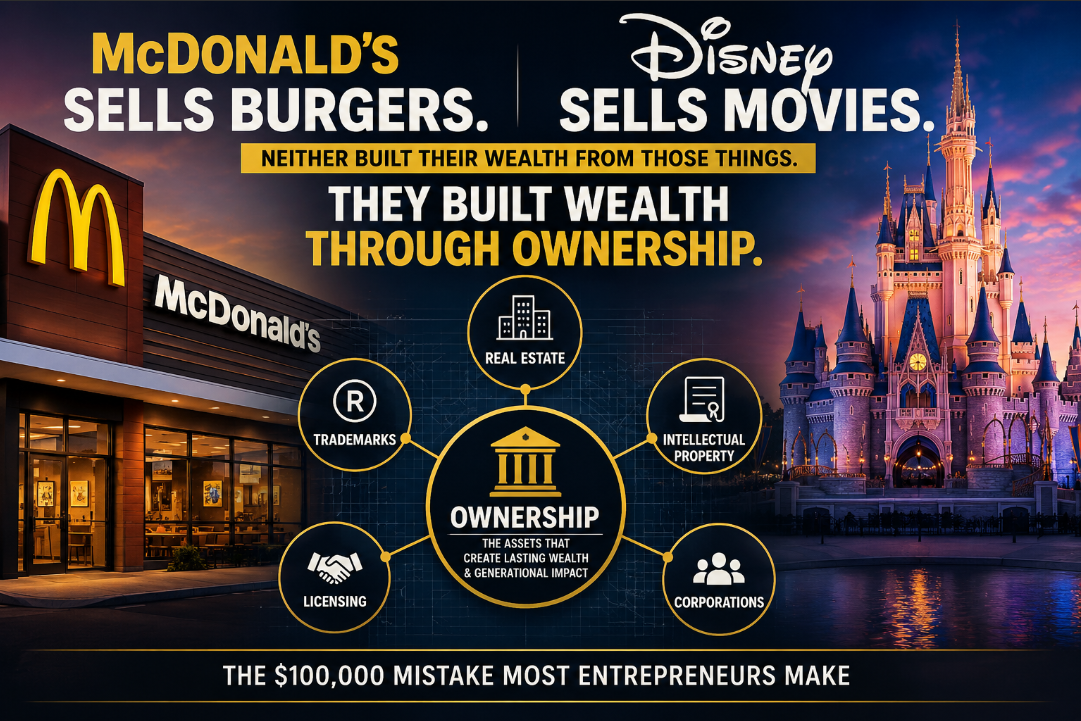
What if the biggest mistake entrepreneurs make isn’t paying too much in taxes?
What if the biggest mistake is spending years building assets they never properly learned how to own, protect, or leverage?
Most entrepreneurs focus on income.
The wealthiest organizations focus on ownership.
Understanding the difference may be one of the most important financial lessons you’ll ever learn.

Most entrepreneurs spend their entire lives chasing income.
The wealthiest organizations in the world spend their lives building ownership.
At first glance, those sound like the same thing.
They’re not.
Income and ownership are two completely different concepts.
One pays your bills.
The other builds your future.
One requires your continued participation.
The other can continue producing value long after you’re gone.
Unfortunately, most entrepreneurs are never taught the difference.
Schools teach people how to earn money.
They rarely teach people how to own assets.
As a result, millions of entrepreneurs spend decades building businesses without ever building true ownership.
They focus on sales.
They focus on revenue.
They focus on customers.
They focus on taxes.
Meanwhile, some of the most successful organizations in America are asking a completely different question:
Who owns the asset?
Not:
- Who operates it?
- Who manages it?
- Who works in it?
But:
Who owns it?
That question alone has created billions of dollars in wealth.
Let’s look at two of the most recognizable organizations in the world.
McDonald’s.
Disney.
And what they understand that most entrepreneurs never learn.
The Lesson Hidden Inside McDonald’s
Most people believe McDonald’s is in the hamburger business.
They are not entirely wrong.
McDonald’s sells hamburgers.
But hamburgers are not what made McDonald’s one of the most valuable organizations in the world.
Ownership did.
In 1954, Ray Kroc discovered a small restaurant owned by Richard and Maurice McDonald.
The restaurant was successful because of its speed, efficiency, and systems.
Ray Kroc saw something bigger.
Most people would have focused on selling more hamburgers.
Ray Kroc focused on creating a system that could be replicated.
Then he focused on ownership.
This is where the story gets interesting.
Most franchise systems simply collect franchise fees.
McDonald’s evolved into something much more powerful.
Under McDonald’s franchise model, the company frequently owns the land, owns the building, or controls the property through long-term leases. Franchisees operate the restaurant and pay McDonald’s rent and royalties based on sales.
Think about what that means.
The franchisee:
- Hires employees
- Manages daily operations
- Purchases inventory
- Serves customers
- Pays utilities
- Handles staffing
Yet McDonald’s often owns or controls the real estate.
The franchisee operates.
McDonald’s owns.
That distinction is everything.
McDonald’s understood a lesson that most entrepreneurs never learn:
The asset is often more valuable than the activity.
The franchise owner may generate revenue.
But McDonald’s owns:
- The brand
- The trademarks
- The operating system
- The intellectual property
- The franchise model
- The leverage
The restaurant operator is responsible for operations.
McDonald’s is responsible for ownership.
That is a completely different level of thinking.
Most entrepreneurs ask:
How much can I sell?
McDonald’s asks:
What can we own?
The answer to that question helped transform a restaurant company into one of the most recognized organizations on Earth.
McDonald’s Didn’t Stop at Real Estate
Most people stop learning after hearing:
“McDonald’s is a real estate company.”
But the lesson is much bigger than real estate.
McDonald’s owns far more than land.
McDonald’s owns:
- Trademarks
- Logos
- Brand identity
- Operating systems
- Marketing systems
- Franchise systems
- Intellectual property
- Real estate interests
Every one of those assets generates value.
Every one of those assets can be licensed.
Every one of those assets can produce income.
The restaurant operator may operate the location.
But McDonald’s owns the system.
This is the difference between operating a business and building ownership architecture.
The Disney Lesson
Disney provides another incredible example.
Most people believe Disney makes money from movies.
That is only partially true.
Movies generate revenue.
Ownership generates wealth.
Consider what Disney owns.
Disney owns:
- Mickey Mouse
- Marvel
- Star Wars
- Pixar
- ESPN
- Trademarks
- Characters
- Stories
- Licensing rights
A movie may earn revenue once.
Intellectual property can generate revenue forever.
One movie can become:
- Toys
- Merchandise
- Licensing agreements
- Streaming revenue
- Theme park attractions
- Television content
- Publishing rights
- International licensing
The movie itself is not the greatest asset.
Ownership of the intellectual property is.
Disney understands something most entrepreneurs never consider:
The asset often becomes more valuable than the activity that created it.
A character can continue generating revenue decades after it was created.
A trademark can continue generating value for generations.
A brand can outlive its founder.
Ownership creates leverage.
Leverage creates scale.
Scale creates wealth.
The Day Everything Collapses
Most entrepreneurs believe risk comes from not making enough money.
In reality, some of the biggest risks come from owning everything under one roof.
Imagine you own:
- Your business
- Your website
- Your trademark
- Your intellectual property
- Your equipment
- Your real estate
- Your customer contracts
- Your bank accounts
Now imagine all of those things live under one entity.
One umbrella.
One roof.
One bucket.
At first, that sounds simple.
Until something goes wrong.
- A lawsuit
- A judgment
- A creditor issue
- A tax issue
- A contract dispute
- An employee claim
- A customer claim
- A frozen bank account
Suddenly the issue isn’t affecting one asset.
It’s affecting every asset.
Because everything lives in the same place.
The same roof that protects everything can become the same roof that causes everything to collapse.
Imagine building:
- A million-dollar brand
- Valuable intellectual property
- Real estate
- Customer relationships
- Revenue-producing assets
Only to watch all of those assets become exposed because they were never separated.
The issue isn’t how much money you make.
The issue is whether everything you own is connected to everything else you own.
McDonald’s doesn’t put everything into one bucket.
Disney doesn’t put everything into one bucket.
Their assets serve different purposes.
Their ownership serves different purposes.
Their intellectual property serves different purposes.
Their operations serve different purposes.
Why?
Because they understand something most entrepreneurs never learn:
Ownership and operation are not the same thing.
The company that creates revenue should not necessarily be the company that owns everything.
Most entrepreneurs spend years trying to grow.
Very few spend time protecting what they grow.
That is why some people build businesses.
While others build legacies.
Why Corporations Think Differently
This is where many entrepreneurs discover something they were never taught.
Most people start businesses thinking about operations.
Very few think about ownership architecture.
A corporation is recognized as its own legal person under the law.
It can:
- Own assets
- Enter contracts
- Borrow money
- License intellectual property
- Own other companies
- Continue existing even when ownership changes
That last point is powerful.
Because wealth is rarely built by one asset.
Wealth is often built through multiple assets working together.
Think about McDonald’s.
One part of the organization operates restaurants.
Another part benefits from real estate.
Another part controls the brand.
Another part controls intellectual property.
Another part controls the franchise system.
Together they create a machine.
Disney does the same thing.
One movie becomes intellectual property.
The intellectual property becomes merchandise.
The merchandise becomes licensing.
The licensing becomes recurring revenue.
The recurring revenue funds future growth.
Everything works together.
Most entrepreneurs never build systems like this because nobody ever teaches them how.
Instead, they place everything under one umbrella and hope nothing ever happens.
The problem is not ambition.
The problem is education.
Why Most Entrepreneurs Never Learn This
If you’ve never heard these concepts before, you’re not alone.
Most entrepreneurs never do.
The average person spends years learning how to become an employee.
Very little time is spent learning:
- Asset protection
- Intellectual property ownership
- Licensing
- Holding companies
- Parent companies
- Ownership architecture
- Real estate ownership
- Corporate governance
- Succession planning
Yet these are the exact concepts used every day by some of the most successful organizations in the world.
McDonald’s didn’t become McDonald’s because they sold hamburgers.
Disney didn’t become Disney because they made movies.
Both organizations understood something much bigger.
They understood ownership.
They understood leverage.
They understood that assets can often become more valuable than the activity that created them.
Most entrepreneurs spend their lives working inside their business.
The wealthiest organizations spend their lives building systems that can work without them.
One focuses on income.
The other focuses on ownership.
One focuses on survival.
The other focuses on legacy.
The Question Nobody Ever Taught You to Ask
Most entrepreneurs ask:
How do I make more money?
A better question is:
What am I building?
An even better question is:
Who owns what I am building?
If you create:
- A course
- A trademark
- A brand
- Real estate
- A book
- Software
- Intellectual property
Who owns it?
The answer matters.
More than most people realize.
The Difference Between Income and Ownership
Income pays bills.
Ownership builds wealth.
Income is often temporary.
Ownership can last generations.
Income requires participation.
Ownership can continue working without you.
Many entrepreneurs spend decades pursuing income.
Very few spend decades intentionally building ownership.
That is why some people work for forty years and retire with very little.
While others spend forty years accumulating assets that continue producing value long after they are gone.
The goal should not simply be making money.
The goal should be converting income into assets.
Then converting assets into ownership.
Then converting ownership into legacy.
The Final Question
The wealthiest organizations in the world are not simply better at making money.
They are better at understanding ownership.
McDonald’s understood ownership.
Disney understood ownership.
The most successful organizations in history understand ownership.
The question is not whether you’re successful today.
The question is whether what you’re building can survive tomorrow.
Because every day you delay building ownership architecture is another day you’re concentrating risk under one roof.
Every day you delay separating assets from operations is another day you’re exposing everything you’ve worked to build.
Every day you delay learning how ownership works is another day someone else is building leverage while you’re building liabilities.
McDonald’s understood this.
Disney understood this.
The wealthiest organizations in the world understand this.
The only question left is:
When Will You?
Ready to Learn How Ownership Works?
Most entrepreneurs are never taught ownership architecture, asset protection, intellectual property strategies, or how corporations can work together to create separation, leverage, and long-term legacy.
If you’re ready to learn the concepts behind ownership, asset separation, and business structure, start with our Masterclass.
If you’re ready for implementation and want our team to help you build the foundation, explore the Legacy Builder.
If you’re looking for a complete done-with-you experience where we work alongside you to build the infrastructure, structure, and systems, learn more about the Ultimate Legacy Builder.
Because the goal isn’t simply to make money.
The goal is to build something that lasts.
References
- Internal Revenue Service (IRS) – Business Structures
https://www.irs.gov/businesses/small-businesses-self-employed/business-structures - McDonald’s Investor Relations
https://corporate.mcdonalds.com/corpmcd/investors.html - McDonald’s Annual Reports
https://corporate.mcdonalds.com/corpmcd/investors/financial-information/annual-reports.html - McDonald’s SEC Filings
https://www.sec.gov/edgar/search/ - The Walt Disney Company Investor Relations
https://thewaltdisneycompany.com/investor-relations/ - U.S. Securities and Exchange Commission (SEC)
https://www.sec.gov - Harvard Business Review
https://hbr.org - National Bureau of Economic Research (NBER)
https://www.nber.org


