
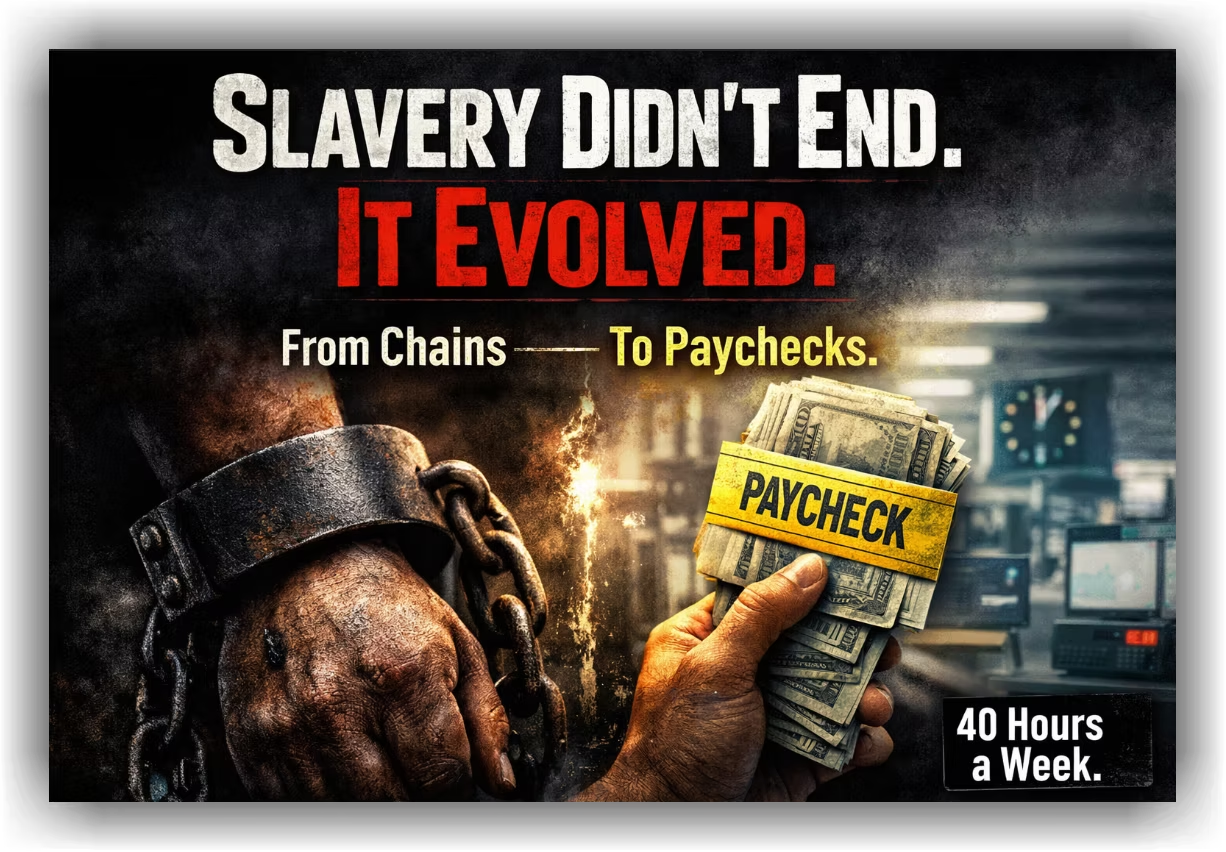
Let’s Be Clear Before We Go Further.
Historic slavery was violent, forced, inhumane, and evil. It involved the physical ownership of human beings. That reality is documented and undeniable.
What we are discussing here is not historical slavery.
We are discussing economic dependency — a system where survival is tied to labor in a way that leaves little room for ownership.
Not chains.
But structure.
And structure is powerful.
The 40-Hour Standard — Where It Actually Came From
The five-day, 40-hour work week became federal law under the
Before that, many industrial workers worked 60–70 hours per week.
In 1926, Henry Ford implemented the five-day, 8-hour schedule at Ford Motor Company. He argued rested workers were more productive and more capable consumers.
But here is what is factual:
- The 40-hour week stabilizes labor markets.
- It structures life around employment.
- It standardizes productivity.
- It creates predictability.
Predictability benefits institutions.
The Math No One Forces You To Look At
There are 168 hours in a week.
Let’s break it down clearly.
Weekly Time Breakdown
| Category | Hours Per Week | Explanation |
| Work | 40 | Standard full-time job |
| Commute | 10 | 1 hour each way × 5 days |
| Sleep | 56 | 8 hours × 7 days |
| Eating / Hygiene / Errands | 14 | ~2 hours daily survival |
| Total Committed Time | 120 |
168 total hours – 120 committed hours = 48 hours remaining
On paper, that looks like freedom.
In reality:
- Your best mental energy went to your employer.
- Saturday becomes recovery.
- Sunday becomes anticipation anxiety.
Those 48 hours are not prime building time.
They are maintenance time.
The Education Pipeline
Education Timeline
| Stage | Years |
| Grades 1–12 | 12 years |
| Bachelor’s Degree | 4 years |
| Master’s Degree | 2 years |
| Total | 18 years |
18 years mastering subjects.
Primarily to qualify for employment.
Not ownership.
Then you enter the workforce around age 22.
The Labor Timeline
| Phase | Years |
| Age 22–65 | 43 years of labor |
| Retirement Age | 65 |
40 hours × 52 weeks × 43 years= 89,440 hours of labor
Nearly 90,000 hours.
Then retirement.
Re-tired.
Tired all over again.
Add the 30-Year Mortgage
The most common U.S. mortgage term is 30 years.
If you purchase at 35:
| Purchase Age | Mortgage Term | Paid Off At |
| 35 | 30 years | 65 |
Your working life and your mortgage life align almost perfectly.
Mortgage requires income.
Income requires employment.
Employment requires compliance.
Not conspiracy.
Structure.
The Paycheck Trap — The Hamster Wheel Effect
According to the U.S. Bureau of Labor Statistics, the average annual wage in the U.S. is around $60,000 (varies by year and occupation).
That equals:
- $5,000 per month (gross)
- Roughly $3,800–$4,200 per month after taxes for many workers
Let’s use $4,000 take-home pay.
Now look at typical monthly household expenses.
Example Monthly Household Expenses
| Expense | Estimated Monthly Cost |
| Mortgage / Rent | $1,800 |
| Utilities | $300 |
| Car Payment | $500 |
| Car Insurance | $200 |
| Gas | $250 |
| Groceries | $700 |
| Health Insurance | $400 |
| Phone / Internet | $250 |
| Miscellaneous / Subscriptions | $300 |
| Total | $4,700 |
Even if you trim some numbers, the margin is thin.
Now watch the cycle:
You get paid.
Within 48 hours:
- Mortgage hits.
- Car payment clears.
- Utilities draft.
- Insurance pulls.
- Groceries are bought.
The paycheck disappears.
Then you wait for the next one.
Work → Get Paid → Pay Bills → Repeat.
That is the hamster wheel.
Without surplus, there is no capital.
Without capital, there is no leverage.
Without leverage, there is no escape velocity.
Why People Feel Stuck
The Federal Reserve’s Survey of Household Economics shows many Americans would struggle to cover a $400 emergency expense without borrowing.
When margin is thin:
Risk feels dangerous.
Entrepreneurship requires:
- Time
- Energy
- Capital
- Emotional stability
The 40-Hour Work Week structure compresses all four.
Not because you are incapable.
Because the margin is small.
Distraction and Attention
While most people are emotionally invested in:
- Political division
- Racial debates
- Religious arguments
- War cycles
- Cultural outrage
Capital reallocates quietly.
During economic downturns:
- Assets discount.
- Markets shift.
- Ownership transfers.
Those with liquidity acquire.
Those without liquidity react.
This is not conspiracy.
This is economic history.
Employment vs Ownership
Employment produces income.
Ownership produces equity.
Income stops when you stop.
Equity compounds when you sleep.
If survival depends entirely on labor, you are economically dependent.
Not chains.
But dependency.
The System Was Designed To Function
Schools prepare you to qualify.
Jobs prepare you to produce.
Mortgages prepare you to commit.
Retirement prepares you to wind down.
The system works.
It maintains order.
But it does not automatically build wealth for you.
It builds stability for the economy.
Stability and freedom are not the same thing.
The Question Most People Avoid
At 65…
Are you financially independent?
Or just finished?
Did you build assets?
Or did you fund someone else’s?
If your paycheck disappears within 48 hours every cycle…
If your margin never expands…
If your time never increases…
Then the system is working exactly as structured.
It keeps you:
- Busy enough
- Paid enough
- Stable enough
- Distracted enough
To never fully pivot into ownership.
If You Don’t Change Your Life, Who Will?
No employer is coming to make you an owner.
No system is going to accidentally hand you leverage.
Ownership must be built intentionally.
If you are serious about stepping out of dependency and into structure, you need more than motivation.
You need a blueprint.
The Legacy Builder is that blueprint.
Operating company.
Parent company.
Holding company.
Asset separation.
Strategic leverage.
This is not about quitting your job tomorrow.
It is about stopping permanent dependency.
You will either spend the next 10 years funding someone else’s dream…
Or building your own.
If you don’t change your life, who will?
The clock is moving.
The structure is working.
The question is whether you are.
Sources & References
- Fair Labor Standards Act
- Henry Ford five-day workweek reform (1926)
- U.S. Bureau of Labor Statistics – Average wage data
- U.S. Census Bureau – Average commute times
- Social Security Administration – Retirement age data
- Federal Reserve – Survey of Household Economics and Decisionmaking (SHED)
- Federal Housing Finance Agency – 30-year mortgage standards


