
Every day, thousands of entrepreneurs hear the same advice.
“Start an LLC.”
Search Google.
Watch YouTube.
Scroll through social media.
Visit LegalZoom.
Browse ZenBusiness.
Look at Tailor Brands.
The recommendation is almost always the same.
Start an LLC.
And to be clear…
There’s nothing inherently wrong with an LLC.
For many entrepreneurs, an LLC may be exactly the right choice depending on their business goals, tax situation, ownership structure, and long-term plans.
But one day, I stopped asking what everyone was recommending.
Instead, I started asking why.
If an LLC is the best solution for every entrepreneur, why do many of the companies selling millions of dollars in LLC formations organize their own businesses differently?
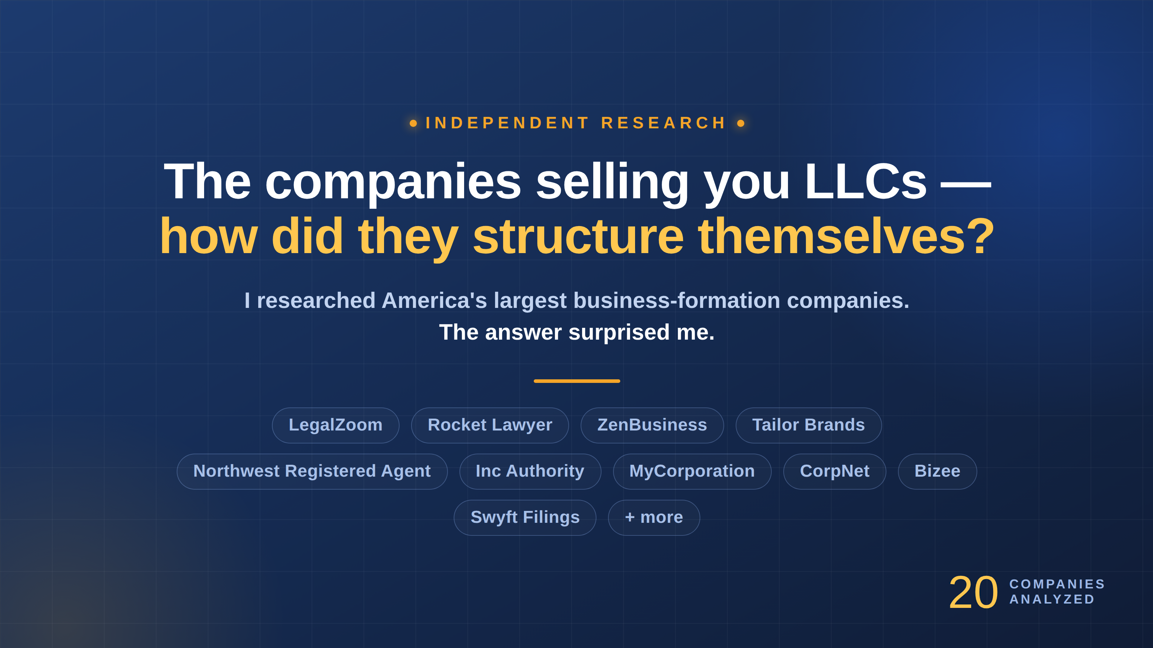
So instead of relying on opinions, I decided to research many of the largest business formation companies in the United States.
Here’s what I found.

What I Found
After reviewing the companies behind some of the biggest names in business formation, one thing immediately stood out.
Many of these companies encourage entrepreneurs to form LLCs, yet many of them have chosen corporate structures for their own businesses.
That observation doesn’t prove a corporation is always the better choice.
It also doesn’t mean an LLC is the wrong choice.
What it does prove is something much more important.
These companies didn’t all make the same decision.
Each company evaluated its own goals, ownership structure, financing, tax considerations, operations, and long-term vision before deciding how to organize itself.
That alone should make every entrepreneur pause.
The Companies Behind the Advice
| LegalZoom | Delaware C-Corporation | Public (NASDAQ: LZ) | ~$756 Million |
| Rocket Lawyer | Delaware C-Corporation | Private | ~$215 Million* |
| ZenBusiness | Texas Public Benefit Corporation | Private | ~$150 Million* |
| Bizee (formerly Incfile) | Texas LLC | Private | ~$110 Million* |
| Northwest Registered Agent | Washington Corporation | Private | ~$100 Million* |
| Tailor Brands | Delaware C-Corporation | Private | ~$85 Million* |
| BizFilings (Wolters Kluwer Division) | Corporate Division | Private | ~$75 Million* |
| Inc Authority | Nevada Corporation | Private | ~$55 Million* |
| MyCorporation | California Corporation | Private | ~$30 Million* |
| CorpNet | California Corporation | Private | ~$25 Million* |
| Swyft Filings | Texas Corporation | Private | ~$20–25 Million* |
| Harbor Compliance | Delaware Corporation | Private | ~$20 Million* |
| MyCompanyWorks | Nevada Corporation | Private | ~$15–20 Million* |
| Active Filings | Corporation | Private | ~$10–15 Million* |
| Direct Incorporation | Delaware Corporation | Private | ~$10–15 Million* |
| InCorp Services | Nevada Corporation | Private | ~$10–15 Million* |
| CorpAmerica | Corporation | Private | ~$8–12 Million* |
| BusinessAnywhere | Corporation | Private | ~$5–10 Million* |
| MyLLC.com | Corporation | Private | Under $10 Million* |
| BetterLegal | Corporation | Private | Under $10 Million* |
Revenue figures for privately held companies are estimates based on publicly available industry information. Private companies generally do not publicly disclose their financial results.
What Stood Out?
After reviewing these companies, one thing became obvious.
Many of the largest companies helping entrepreneurs form LLCs are themselves organized as corporations.
Others chose different entity types.
That doesn’t prove one structure is universally better than another.
What it does prove is something much more important.
These companies didn’t all make the same decision.
Each one evaluated its own goals, ownership, financing, tax considerations, operations, and long-term vision before deciding how to structure its business.
That should make every entrepreneur pause.
The Bigger Lesson
Too many people ask the wrong question.
They ask:
“Should I start an LLC?”
That’s not the question.
The better question is:
“What business structure best fits the business I’m trying to build?”
Those are completely different conversations.
Business Structure Is a Strategy
Imagine hiring a financial advisor.
You tell them:
- Your age
- Your income
- Your retirement goals
- Your risk tolerance
And they recommend the exact same investment portfolio to every single client.
Would you trust them?
Probably not.
Because different people require different strategies.
Business entities work the same way.
There isn’t one entity that’s right for everyone.
There never has been.
Stop Following the Crowd
One of the biggest mistakes entrepreneurs make is assuming popularity equals correctness.
Just because something is recommended most often doesn’t automatically make it the best choice for your business.
Successful business owners don’t simply copy what everyone else is doing.
They ask better questions.
They understand why they’re making the decisions they’re making.
Education Comes Before Formation
Whether you ultimately choose an LLC, a corporation, or another legal structure isn’t the point.
The point is understanding why.
Because once your business begins growing, changing your entity later can be more expensive, more time-consuming, and more disruptive than making an informed decision from the beginning.
Education should always come before paperwork.
Before You Form Your Business…
Ask yourself:
- What am I trying to build?
- Will I eventually seek investors?
- How do I want my business taxed?
- What happens if I want to scale nationally?
- How will ownership transfer in the future?
- What are my long-term goals?
Those questions matter far more than simply asking,
“Should I get an LLC?”
Conclusion
This article isn’t about proving that corporations are better than LLCs.
It isn’t about criticizing the companies listed above.
In fact, many of these companies have helped millions of entrepreneurs start businesses.
The purpose of this article is much simpler.
Think before you copy.
The companies listed above built businesses worth millions of dollars.
Each made a deliberate decision about how to structure its own business.
Shouldn’t you do the same?
Before you pay someone to form your business, ask one more question:
Why did they choose the structure they chose for themselves?
The answer may not change your decision.
But understanding why may change how you make it.
About This Research
This article is based on publicly available business registration records, SEC filings for publicly traded companies, corporate disclosures, and other publicly available information. Business entity types and states of incorporation are matters of public record where applicable. Annual revenue figures for privately held companies are estimates because private businesses generally are not required to disclose their financial results.
Disclaimer: This article is provided for educational purposes only and does not constitute legal, tax, or financial advice. The appropriate business structure depends on each entrepreneur’s specific goals, facts, and circumstances. Consult qualified legal and tax professionals before making decisions regarding your business entity.


Perfect example of the Winston Churchill quote: “I no longer listen to what people say, I just watch what they do. Behavior never lies.”