
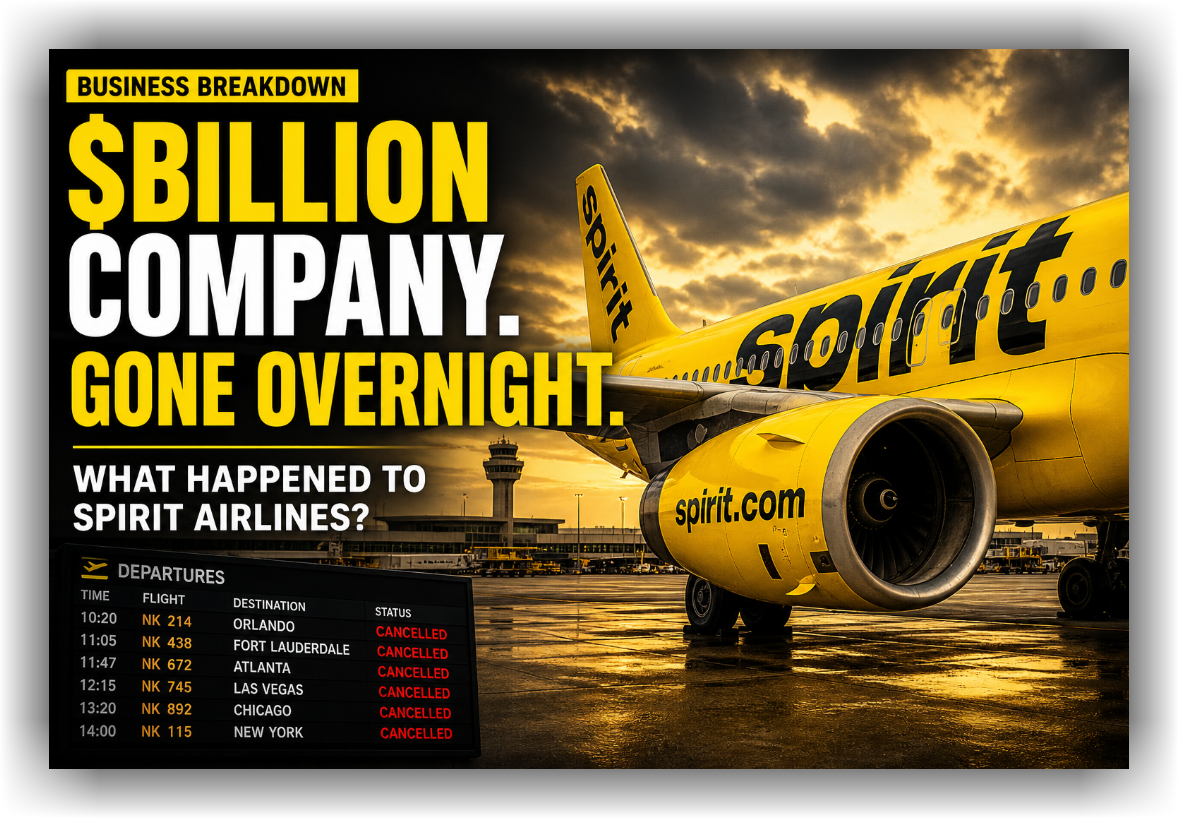
What Really Happened — And the Business Lessons Most Entrepreneurs Are Missing

A $Billion Company Didn’t Fail Overnight
On May 2, 2026, Spirit Airlines officially shut down all operations.
Flights were canceled.
Customer service ended.
Operations stopped immediately.
To the public, it looked sudden.
But behind the scenes?
This was a multi-year financial breakdown—driven by rising costs, strategic missteps, and a business model that could not survive pressure.
And for business owners, this isn’t just news.
This is one of the clearest real-world case studies on why businesses fail—even when they have customers, revenue, and brand recognition.

🧾 Timeline of Events: How Spirit Airlines Collapsed
2024: The Deal That Didn’t Happen
In January 2024, a federal judge blocked Spirit Airlines’ $3.8 billion merger with JetBlue.
This wasn’t just another corporate deal.
It was a survival move.
The merger would have:
- Strengthened financial stability
- Improved operational positioning
- Provided long-term scalability
Once it was blocked, Spirit lost its strongest path forward.
November 2024: First Bankruptcy Filing
By late 2024, Spirit filed for Chapter 11 bankruptcy protection.
Primary causes:
- Rising operating costs
- Mounting debt
- Loss of strategic direction
The company attempted to restructure—but the core issues remained.
2025: Temporary Fix, Permanent Problem
- March 2025: Exits bankruptcy
- August 2025: Files bankruptcy again
That second filing tells you everything:
The restructuring didn’t solve the problem—it only delayed it.
During this time:
- Routes were cut
- Employees were laid off
- Aircraft expansion slowed
- Cash flow continued declining
2025–2026: The Slow Breakdown
As pressure increased:
- Fuel prices surged
- Customer expectations shifted
- Competition intensified
At the same time:
- Debt remained high
- Revenue stability weakened
2026: Final Shutdown
By early 2026:
- Spirit attempted to secure a $500M bailout
- Creditors refused additional support
- Financing options disappeared
On May 2, 2026, operations ended completely.
Not because demand disappeared…
but because liquidity did.
Why Spirit Airlines Failed: The Real Causes
1. Rising Fuel Costs Crushed Margins
Fuel is one of the largest expenses in aviation.
When fuel costs rise:
- Profit margins shrink immediately
- Operating costs increase across every route
Spirit’s model relied on low operating costs.
When fuel prices surged, the model became unsustainable.
2. The Ultra-Low-Cost Model Stopped Working
Spirit built its brand on being the cheapest airline.
This included:
- Low ticket prices
- Additional fees for services
For years, this drove volume.
But over time:
- Competitors improved pricing
- Customers demanded better experiences
- Market expectations evolved
Spirit became stuck:
- Unable to raise prices
- Unable to lower costs further
3. The Blocked JetBlue Merger Was a Turning Point
The failed merger removed:
- Capital support
- Strategic alignment
- A viable exit strategy
Without it, Spirit was forced to survive independently.
4. Excessive Debt Limited Flexibility
High debt created constant pressure:
- Payments had to be made regardless of revenue
- Financial flexibility disappeared
- Risk increased over time
Eventually, control shifted to creditors.
When creditors control decisions, ownership becomes secondary.
5. Creditors Refused Further Support
At the final stage:
- Bondholders rejected restructuring
- Lenders stopped providing capital
This is the true point of failure:
Businesses don’t collapse when revenue drops.
They collapse when capital access disappears.
6. No Government Bailout
Spirit attempted to secure government assistance.
It failed.
Reasons included:
- Not considered system-critical
- Weak recovery outlook
- Political resistance
The reality: If your business is not essential, no one is coming to save it.
7. Post-COVID Market Shifts
After COVID:
- Travel demand became unpredictable
- Costs increased significantly
- Customer preferences shifted toward comfort and reliability
Spirit’s model—built on volume and low pricing—no longer aligned with the market.
The Core Lesson: Why “Cheap” Is Not a Sustainable Strategy
This is where the real lesson begins.
Cheap Drives Sales — But It Destroys Stability
Spirit’s model was simple:
Be the cheapest option.
This strategy:
- Attracted customers
- Increased bookings
- Generated revenue
But it created a major problem:
It eliminated margin.
The Hidden Cost of Low Pricing
Competing on price alone leads to:
- Thin profit margins
- Limited operational flexibility
- Constant cost-cutting
When external pressure hits, there is no cushion.
External Events Exposed the Weakness
When the following occurred:
- COVID disruption
- Fuel price increases
- Inflation
Spirit couldn’t adapt.
Because the business model only worked under ideal conditions.
Customer Experience Declined
To maintain low prices, Spirit reduced:
- Customer service quality
- Operational flexibility
- Overall experience
This resulted in:
- Negative brand perception
- Reduced customer loyalty
- Limited pricing power
The Collapse Cycle
- Lower prices to attract customers
- Cut costs to maintain profitability
- Experience declines
- Brand weakens
- Prices cannot increase
- Costs rise
- Margins disappear
- Debt increases
- Business fails
What This Means for Business Owners
This is not just about airlines.
This is happening across industries every day.
Business owners are:
- Undercutting their own pricing
- Competing solely on cost
- Over-delivering and undercharging
- Prioritizing short-term revenue over long-term stability
The Reality Most Won’t Say
Customers love cheap…
but cheap can cost you your business.
What Spirit Airlines Proves
- Revenue alone does not protect a business
- Structure alone does not guarantee success
- Customers alone do not create stability
The key factor is:
Control over cash flow, margin, and positioning
How to Build a Business That Survives
A sustainable business requires:
Strong Margins
Profit—not just revenue
Cash Flow Control
Predictability and reserves
Strategic Pricing
Positioning—not undercutting
Operational Flexibility
Ability to adapt to change
Long-Term Thinking
Decisions based on sustainability
The Aftermath
Legal Fallout
Potential legal actions may include:
- Customer refund disputes
- Employee claims
- Investor-related litigation
Most cases will proceed through bankruptcy courts.
Industry Impact
- Reduced competition
- Potential increase in airfare pricing
- Competitors absorbing routes and customers
Final Takeaway
Spirit Airlines had:
- Millions of customers
- Billions in revenue
- National brand recognition
- Access to capital
And still failed.
Why?
Not because demand disappeared.
Not because they lacked structure.
But because:
They lost control of their financial position.
Closing Statement
Spirit Airlines didn’t fail because people stopped flying.
They failed because their model depended on being the cheapest—
and when the world changed, that model broke.
Cheap brought customers.
But it removed the ability to adapt.
And in business:
If you can’t adapt, you won’t survive.
Build the Right Foundation
Most business owners focus on:
- Starting a business
- Generating revenue
- Getting customers
But very few focus on:
- Structure
- Cash flow strategy
- Long-term positioning
That’s where businesses either survive—or fail.
If you’re serious about building a business that lasts,
you need more than just an idea.
You need a strategy.
Learn how to structure your business the right way:
📚 References
🟡 Reuters – Spirit Airlines restructuring & shutdown
- Spirit Airlines shuts down after failed rescue deal
- Spirit prepares to cease operations overnight (Reuters)
👉 Key takeaway: Fuel price surge + failed bailout + creditor refusal led to shutdown
🟡 Wall Street Journal – Merger & creditor negotiations
👉 Key takeaway: Bondholders and government couldn’t agree on rescue financing
🟡 Business Insider – Official shutdown announcement
👉 Key takeaway: Two bankruptcies + failed bailout = immediate shutdown
🟡 The Guardian – Full collapse analysis
👉 Key takeaway: Oil prices + blocked JetBlue merger accelerated failure
🟡 ABC News (6abc) – Bankruptcy filing (2024)
👉 Key takeaway: First bankruptcy in Nov 2024, followed by second in 2025
🟡 Washington Post – Government bailout discussion
👉 Key takeaway: Not “too big to fail,” bailout rejected
🟡 Fortune / Industry Insight (via Reuters data)
👉 Key takeaway: Fuel costs nearly doubled vs projections, wiping out margins
🟡 AOL News – Timeline of decline
👉 Key takeaway: Financial projections failed due to rising fuel costs
🟡 Public Corporate Filings / Industry Data
👉 Key takeaway: Filed bankruptcy twice (2024, 2025) before shutting down in 2026


